What Is 12-Step Alcohol Rehab (And Is It Right for You)?
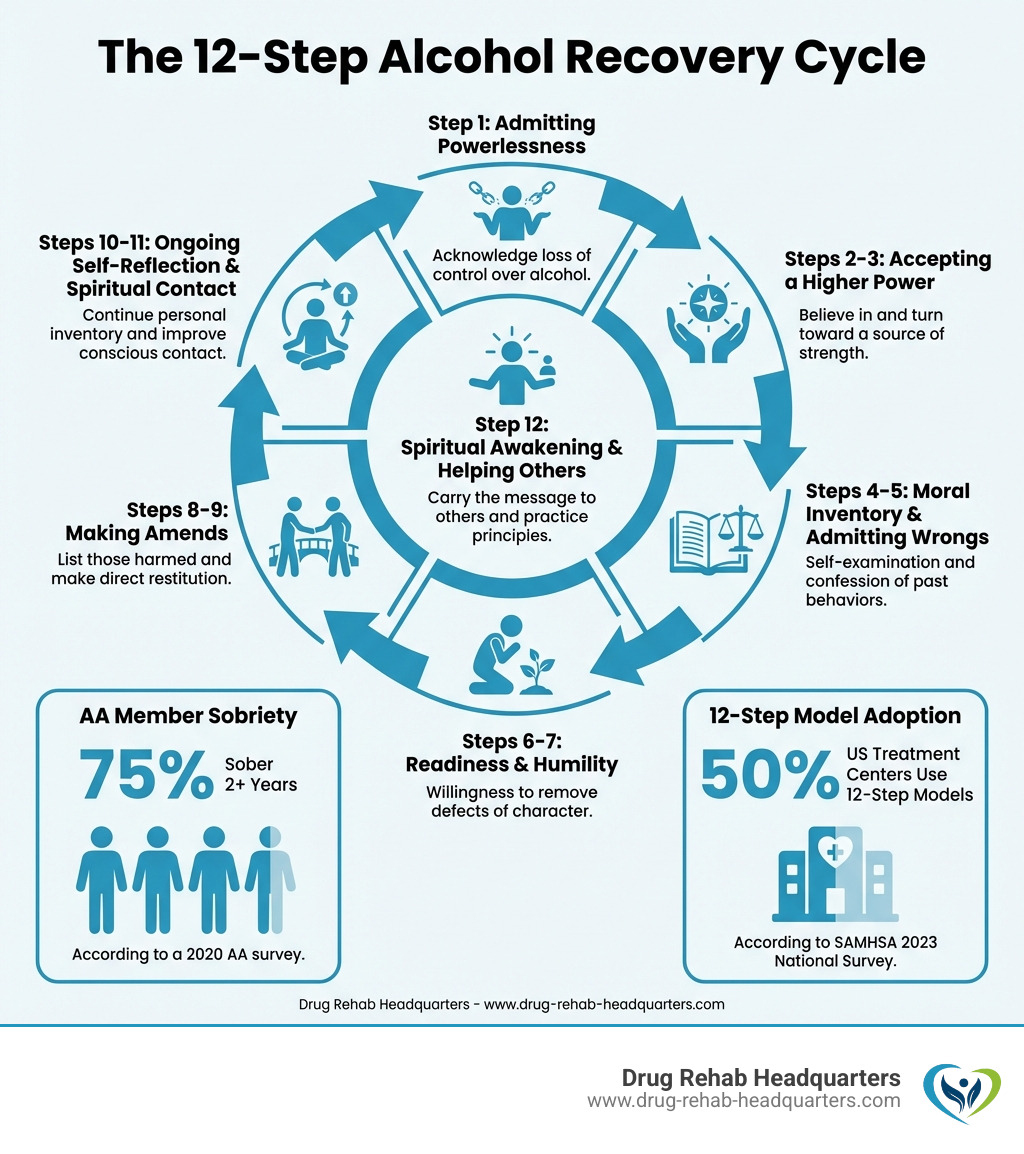
12-step alcohol rehab is one of the most widely used frameworks for overcoming alcohol addiction in the world. Here’s a quick overview of what it involves:
- What it is: A structured, peer-supported recovery program built around 12 guiding principles
- Who created it: Bill Wilson and Dr. Bob Smith, founders of Alcoholics Anonymous (AA), in 1935
- How it works: Regular meetings, working through 12 steps with a sponsor, and building a sober support network
- Who it’s for: Anyone with a desire to stop drinking — no religious belief or “rock bottom” required
- Does it work? According to a 2020 AA survey, 75% of members had been sober for at least 2 years
- Where to start: Call (866) 720-3784 for free, confidential guidance on finding a program near you
Millions of people struggle with alcohol addiction every year. The options can feel overwhelming — detox, inpatient rehab, drug treatment centers, outpatient programs, therapy, support groups. It’s hard to know where to start.
That’s where 12-step programs come in. Since the 1930s, this framework has helped countless people build lasting sobriety — not through willpower alone, but through community, honesty, and structured personal growth.
According to SAMHSA’s 2023 National Survey, nearly 50% of treatment centers nationwide use 12-step models. That’s not an accident. These programs work for a lot of people — and understanding how they work is the first step to deciding if they’re right for you.
At Drug Rehab Headquarters, we’ve spent years helping individuals and families navigate alcohol and drug treatment options across North America, including connecting people with the right 12-step alcohol rehab programs for their unique situation. If you need help right now, call us at (866) 720-3784 — we’re here 24/7.
12 step alcohol rehab helpful reading:
History and Framework of 12-Step Alcohol Rehab
The story of the 12-step alcohol rehab model begins in 1935 in Akron, Ohio. Bill Wilson, a New York stockbroker, and Dr. Bob Smith, an Ohio surgeon, both struggled with “hopeless” alcoholism. They discovered that by sharing their experiences and supporting one another, they could maintain sobriety. This fellowship eventually became Alcoholics Anonymous (AA).
In 1939, they published the “Big Book,” which outlined the 12-step program we know today. Originally influenced by the Oxford Group—a Christian organization—the program was designed to be a spiritual journey rather than a medical one. However, the founders were careful to make the language inclusive, allowing individuals to define their own “Higher Power.”
The framework is built on several core pillars:
- Honesty and Powerlessness: Admitting that alcohol has made life unmanageable.
- Surrender: Believing that a power greater than oneself can restore sanity.
- Moral Inventory: Conducting a “searching and fearless” look at one’s own character.
- Amends: Taking personal responsibility by apologizing and making things right with those harmed.
- Service: Helping other alcoholics as a way to maintain one’s own spiritual awakening.
While it started with alcohol, this model proved so effective that it was adapted for drug treatment centers as well, giving birth to Narcotics Anonymous (NA), Cocaine Anonymous (CA), and dozens of others. If you are struggling with any substance, help is available right now at (866) 720-3784.
How 12-Step Alcohol Rehab Works in Practice
In a practical sense, a 12-step alcohol rehab program isn’t just a list of rules; it’s a community. When you enter inpatient rehab or join a local group, you’ll encounter several key components that make the program function:
- Meetings: These are the heartbeat of the program. Open meetings allow anyone to attend, including family members or students. Closed meetings are reserved strictly for those who have a desire to stop drinking. In these spaces, members share their “experience, strength, and hope” without fear of judgment.
- Sponsorship: A sponsor is a person further along in recovery (usually with at least one year of sobriety) who provides one-on-one guidance. They help you navigate the steps and provide accountability during cravings or crises.
- The 12 Traditions: While the Steps are for the individual, the Traditions are for the group. they ensure that groups remain autonomous, non-professional, and focused solely on the primary purpose: helping the alcoholic who still suffers.
- The “90 in 90” Rule: Newcomers are often encouraged to attend 90 meetings in 90 days. This helps break old habits and builds a new, sober social circle quickly.
Whether you are looking for a local meeting or a comprehensive alcohol rehab centers guide, our team at Drug Rehab Headquarters can help you find a facility that integrates these principles. Call us at (866) 720-3784.
Benefits and Evidence-Based Success Rates
One of the biggest misconceptions about 12-step alcohol rehab is that it lacks scientific backing because of its spiritual nature. On the contrary, decades of research show that peer-led mutual help groups significantly improve long-term outcomes.
According to a 2020 survey of AA members, a staggering 75% of members had been sober for at least 2 years. Conversely, only 10% of the membership consisted of people sober for less than six months, suggesting that once people “stick” with the program, their chances of long-term success skyrocket.
Key benefits include:
- Peer Accountability: Knowing you have a meeting to attend or a sponsor to call reduces the isolation that often leads to relapse.
- Cost-Effectiveness: AA and NA meetings are free, making them an accessible form of aftercare for anyone leaving an inpatient rehab.
- Improved Psychosocial Functioning: Studies indicate that active participation—not just sitting in the back of the room, but doing service and working the steps—leads to higher self-efficacy and lower stress.
- Structure: For many, the transition from alcohol detox back to “real life” is the most dangerous time. The 12 steps provide a clear roadmap for what to do next.
If you’re worried about the first few days of sobriety, medical supervision is often necessary. We can help you find a safe place to start. Call (866) 720-3784 for more information.
Integrating Spirituality and Professional Care
A common hurdle for many is the mention of “God” or a “Higher Power.” However, modern 12-step alcohol rehab is incredibly flexible. A Higher Power can be the “Group Of Drunks” (G.O.D.), nature, science, or simply the collective strength of the recovery community. The goal is to acknowledge that you cannot beat addiction alone.
Furthermore, 12-step programs are increasingly integrated with professional medical care. Many people in recovery have a “dual diagnosis,” meaning they struggle with both addiction and a mental health disorder like depression or PTSD.
Professional alcohol addiction rehab options often combine:
- Cognitive Behavioral Therapy (CBT): To identify and change negative thought patterns.
- Dual Recovery Anonymous (DRA): A specialized 12-step meeting for those with co-occurring disorders.
- Medication-Assisted Treatment (MAT): To manage cravings while working the spiritual steps.
The “faith meets science” approach is often the most robust way to tackle addiction. If you need a facility that offers both clinical excellence and 12-step facilitation, call us at (866) 720-3784.
Finding the Right 12-Step Alcohol Rehab for You
At Drug Rehab Headquarters, we know that no two journeys are the same. Some people thrive in a highly structured, faith-based environment, while others prefer a secular, holistic approach. Our mission is to provide personalized guidance to help you find rehab centers for alcoholics that meet your specific needs.
We serve all of North America, from the mountains of Colorado to the coasts of Florida and everywhere in between. Our certified counselors—many of whom have lived experience with recovery—are available 24/7 to discuss your options. Whether you need an intensive drug treatment center or a specialized 12-step facilitation program, we can help.
Take the first step today. You don’t have to carry this burden alone. Reach out to us at (866) 720-3784.
Alternatives to the Traditional 12-Step Model
While the 12-step model is incredibly successful, it isn’t the only path to sobriety. Some people find that the emphasis on “powerlessness” or the spiritual language doesn’t resonate with them. Fortunately, there are several “Non 12-Step Rehab Centers” and support groups that offer different philosophies.
| Feature | 12-Step Programs (AA/NA) | SMART Recovery |
|---|---|---|
| Core Philosophy | Spiritual growth & surrendering to a Higher Power | Self-empowerment & cognitive tools |
| View of Addiction | A progressive disease | A maladaptive behavior that can be unlearned |
| Meeting Style | Peer-led sharing of experience | Facilitator-led “cross-talk” and tool-building |
| Goal | Total abstinence | Total abstinence (usually) |
| Foundation | 12 Steps and 12 Traditions | 4-Point Program (CBT/REBT based) |
Other popular alternatives include:
- LifeRing Secular Recovery: Focuses on the “Sober Self” vs. the “Addict Self.”
- Women for Sobriety (WFS): A gender-specific program focusing on 13 “Acceptance Statements” and positive reinforcement.
- Secular Organizations for Sobriety (SOS): Emphasizes personal responsibility and the “Sobriety Priority.”
Regardless of the method you choose, the most important factor is taking action. If you’re unsure which model fits your personality, our counselors at (866) 720-3784 can walk you through the differences.
Frequently Asked Questions about 12-Step Rehab
How long does it take to complete the 12 steps?
There is no “finish line” in a 12-step alcohol rehab. While some people work through the steps in a few months, most practitioners view them as a lifelong practice. Steps 10, 11, and 12 are considered “maintenance steps” that you continue to do every day to stay grounded.
Do I have to be religious to join a 12-step program?
Absolutely not. While the steps use the word “God,” the program explicitly states it is “God as we understood Him.” Many atheists and agnostics successfully use the 12 steps by choosing a Higher Power that makes sense to them, such as the power of the recovery group itself or the beauty of the natural world.
What is the role of a sponsor in recovery?
A sponsor acts as a mentor and a guide. They aren’t therapists or doctors; they are simply people who have walked the path before you. They help you stay honest during your “moral inventory” and provide a safe person to call when you feel like drinking or using drugs.
Conclusion
Recovery is not a solo mission. Whether you choose a traditional 12-step alcohol rehab or a modern secular alternative, the key is finding a community that supports your growth. At Drug Rehab Headquarters, we are dedicated to connecting you with the best evidence-based and holistic treatment options across North America.
Our certified counselors are standing by 24/7 to offer you free, confidential support. We understand the struggle because many of us have been there ourselves. From finding the right inpatient rehab to locating a drug treatment center that accepts your insurance, we are here to simplify the process.
Don’t wait for things to get worse. Beyond the bottle, there is a life of purpose, connection, and joy waiting for you. Call us today at (866) 720-3784 and let’s start your journey together.