
Detailed Guide to Does Insurance Cover Rehab
Navigating health insurance can feel like trying to solve a Rubik’s Cube in the dark. However, two major federal laws have cleared the path for millions of Americans to access life-saving care at drug treatment centers.
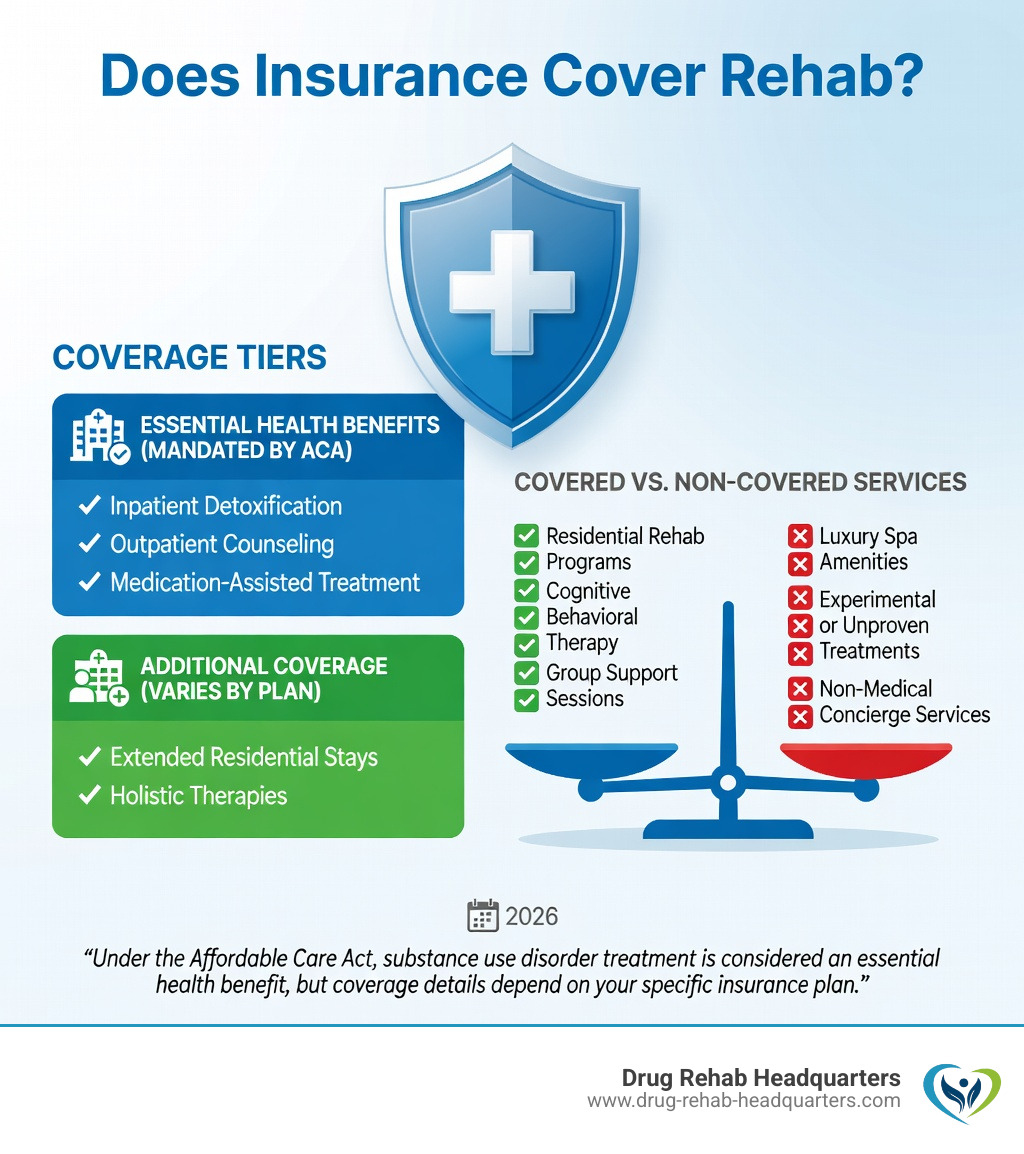
First, the Affordable Care Act (ACA), signed into law in 2010, changed the game for anyone asking, “Does Insurance Cover Rehab?” Under the ACA, substance use disorder (SUD) services are classified as “Essential Health Benefits.” This means that all health plans offered on the Health Insurance Marketplace must provide coverage for addiction treatment. Furthermore, the ACA ensures that you cannot be denied coverage or charged more because of a “pre-existing condition”—and yes, addiction is recognized as a medical condition, not a moral failing.
Second, The Mental Health Parity and Addiction Equity Act (MHPAEA) of 2008 requires insurance providers to treat mental health and substance use benefits with the same “parity” as medical and surgical benefits. In simple terms: if your plan offers unlimited doctor visits for a broken leg, they generally cannot place arbitrary, stricter limits on visits for addiction counseling.
These laws apply to most employer-based plans, Marketplace plans, and even many Medicaid programs. If you are unsure if your plan follows these mandates, our certified counselors at Drug Rehab Headquarters are available 24/7 at (866) 720-3784 to help you understand your rights.
Does Insurance Cover Rehab for All Levels of Care?
When people ask, “Does Insurance Cover Rehab?” they are often picturing a specific type of care, like a 30-day stay in a residential facility. The reality is that addiction treatment is a continuum, and insurance typically covers various levels of care based on “medical necessity.”

Most comprehensive plans provide coverage for:
- Inpatient Rehab: This involves living at a facility 24/7 to receive intensive therapy and medical monitoring. It is often the most recommended level of care for those with severe addictions or unstable home environments.
- Partial Hospitalization Programs (PHP): You spend the day at a treatment center but return home (or to a sober living house) at night.
- Intensive Outpatient Programs (IOP): These provide several hours of therapy per week while allowing you to maintain work or school commitments.
- Standard Outpatient Care: Regular sessions with a licensed counselor or therapist.
You can learn more about these different options in our Detailed Guide to Does Insurance Cover Rehab?. Whether you need high-intensity inpatient rehab or flexible outpatient support, we can help you find a facility that matches your coverage by calling (866) 720-3784.
Does Insurance Cover Rehab for Medical Detox?
Medical detoxification is often the first and most critical step in the recovery journey. Withdrawing from substances like alcohol, benzodiazepines, or opioids can be physically dangerous and, in some cases, life-threatening.
Insurance providers generally recognize this as a medical necessity. Most plans cover “withdrawal management,” which includes 24/7 medical supervision and the use of medications to ease symptoms and prevent complications. This falls under the Cost of Rehab umbrella, and while it is a specialized service, it is widely supported by major insurers.
Does Insurance Cover Rehab if I Relapse?
Relapse is often a part of the recovery process, not a sign of failure. However, a common fear is: “Will my insurance pay for me to go back?”
The answer is usually yes, but it depends on your plan’s specific terms and the concept of “medical necessity.” Under the ACA, there are no lifetime dollar limits on essential health benefits. However, an insurance company might require a clinical assessment to prove that a repeat stay in inpatient rehab is the most appropriate level of care. If a claim is denied, you have the right to appeal. For a deeper dive into the financial aspects of long-term recovery, check out our resource on The Price of Recovery.
Major Providers and Public Insurance Options
If you have a card from a major national insurance provider, you likely have access to a vast network of drug treatment centers.
- Blue Cross Blue Shield (BCBS): Nearly one in three Americans is covered by a BCBS plan. They have extensive behavioral health networks in every state.
- Aetna: Known for an individualized approach to care, Aetna often covers a range of services from detox to aftercare.
- Cigna: Cigna serves over 190 million customers worldwide and offers robust resources for substance use disorders.
- UnitedHealthcare (UHC): Through its Optum division, UHC provides comprehensive coverage for evidence-based addiction treatments.
For those who need additional assistance, the federal government offers Mental Health and Substance Use Insurance Help through various departments. You can also reach us at (866) 720-3784 to see which of these major providers are in-network with facilities near you.
Medicare and Medicaid Coverage for Addiction
Public insurance options provide a vital safety net for millions of Americans.
- Medicare:
- Part A covers inpatient stays in a psychiatric hospital or a general hospital for rehab.
- Part B covers outpatient services, including visits with psychologists, social workers, and partial hospitalization.
- Part D covers many medications used in treatment, though coverage for certain medications like methadone may vary.
- Medicaid: This is a state-administered program for low-income individuals and families. While benefits vary by state, Medicaid is a major payer for addiction services. In states like Connecticut, Medicaid provides comprehensive coverage for outpatient care and medication-assisted treatment (MAT). In Tennessee, while there have been historically high numbers of uninsured residents (over 644,000 in 2023), those who qualify for TennCare (the state’s Medicaid program) can access essential recovery services.
Managing Out-of-Pocket Costs and Network Restrictions
Even when the answer to “Does Insurance Cover Rehab?” is yes, you may still face out-of-pocket costs. Understanding these terms is the best way to avoid “sticker shock” after treatment.
| Term | What It Means for Rehab |
|---|---|
| Deductible | The amount you pay out-of-pocket before your insurance kicks in. |
| Copay | A fixed fee you pay for each visit (e.g., $30 for an outpatient session). |
| Coinsurance | Your percentage of the total cost (e.g., you pay 20%, insurance pays 80%). |
| Out-of-Pocket Max | The most you will have to pay in a year; after this, insurance pays 100%. |
| In-Network | Facilities that have a contract with your insurer (usually much cheaper). |
| Out-of-Network | Facilities without a contract (can be significantly more expensive). |
Choosing an in-network provider is one of the Smart Choices, Sober Future decisions you can make to protect your finances. If you find a facility you love that is out-of-network, you might be able to negotiate a Single Case Agreement (SCA). This is a one-time contract between the insurer and the facility that allows you to receive in-network benefits because the facility offers a specialized service not available elsewhere in the network.
Confused? Don’t be. Our team can explain these costs in plain English at (866) 720-3784.
How to Verify Your Benefits and Start Treatment
The most important step you can take today is to Verify Insurance coverage. You don’t have to do this alone.
When you call us at (866) 720-3784, we recommend having your insurance card ready. Here are some questions we can help you answer:
- Is this facility in-network or out-of-network?
- Does my plan require “prior authorization” before I admit?
- How many days of inpatient rehab are covered?
- What is my remaining deductible for the year?
If you don’t have insurance, don’t lose hope. There are several alternative payment options:
- Sliding Scale Fees: Many non-profit facilities adjust their prices based on your income.
- SAMHSA Grants: State-funded grants can often cover the full cost of treatment for those who qualify.
- Payment Plans: Many private facilities offer financing options that allow you to pay for treatment over time.
- Scholarships: Some organizations provide “beds” for free to individuals who demonstrate a high need and commitment to recovery.
Frequently Asked Questions about Rehab Insurance
Can I go to rehab without insurance?
Absolutely. While insurance makes it easier, it is not the only way. You can access state-funded programs, look for non-profit organizations like the Salvation Army, or utilize sliding-scale facilities. We can help you find these options in your local area across all 50 states and Puerto Rico.
How much does rehab cost with insurance vs. without?
Without insurance, a standard 30-day inpatient rehab stay can range from $2,000 to $25,000, while luxury programs can exceed $80,000. With insurance, your costs are often limited to your deductible and out-of-pocket maximum. For many, this reduces the cost from tens of thousands of dollars to a few thousand or even zero if the deductible has already been met.
Does insurance cover aftercare and counseling?
Yes, most plans cover aftercare services as they are essential for preventing relapse. This includes ongoing therapy, support groups, and sometimes transitional housing services, provided they are medically necessary.
Conclusion
At the end of the day, the cost of rehab is an investment in your life. While the financial aspect of addiction treatment can be daunting, the cost of not getting help is far higher—ranging from lost wages and legal fees to the ultimate price of one’s health.
At Drug Rehab Headquarters, we believe that everyone deserves a chance at a sober future, regardless of their financial situation. We offer 24/7 free support from certified counselors, many of whom have lived experience with addiction. We provide personalized guidance to help you find suitable, evidence-based, and holistic treatment options across North America.
Don’t let the question of “Does Insurance Cover Rehab” keep you from the help you need. We are here to do the heavy lifting for you. Call us today at (866) 720-3784 or visit our page to Verify Insurance online. Your journey to recovery starts with a single, confidential phone call.