
Understanding Your Outpatient Recovery Options
Outpatient Drug Treatment is a flexible form of addiction recovery that allows you to receive professional care while living at home and maintaining your daily responsibilities. Unlike inpatient programs that require you to stay at a facility, outpatient treatment lets you attend therapy sessions, counseling, and medical appointments at scheduled times—often in the evenings or on weekends—so you can continue working, attending school, or caring for your family.
Key facts about outpatient drug treatment:
- Time commitment: Ranges from fewer than 9 hours per week (standard outpatient) to 20+ hours per week (partial hospitalization programs)
- Cost: Generally $2,000-$5,500 for 1-3 months of treatment, significantly less than inpatient care
- Treatment types: Includes Partial Hospitalization Programs (PHP), Intensive Outpatient Programs (IOP), and Standard Outpatient Programs (OP)
- Best for: Individuals with mild to moderate addiction, strong support systems, stable housing, and high motivation to recover
- Services offered: Individual and group therapy, family counseling, medication-assisted treatment (MAT), relapse prevention education, and case management
Insurance coverage: Most private insurance plans, Medicaid, Medicare, and ACA marketplace plans cover outpatient treatment to varying degrees.
If you’re researching treatment options for yourself or someone you care about, you’re likely feeling overwhelmed by the complexity of addiction care. The good news is that outpatient treatment offers a proven path to recovery that works around your life rather than requiring you to put everything on hold.
At Drug Rehab Headquarters, we’ve helped thousands of individuals and families navigate the complex landscape of addiction treatment, including connecting people with effective Outpatient Drug Treatment programs that match their specific needs and circumstances. Our mission is to provide clear, accurate information that empowers you to make informed decisions about recovery.
What is Outpatient Drug Treatment?

At its core, Outpatient Drug Treatment is a non-residential approach to recovery. Think of it like any other specialized medical treatment where you visit a clinic for several hours a day or week but return to the comfort of your own bed at night. This format is designed for individuals who do not require 24/7 medical supervision but still need professional, structured support to overcome substance use disorders (SUDs).
According to Treating Addiction: A Guide for Professionals, outpatient programs can provide nearly all the same clinical services available in residential treatment. This includes evidence-based therapies, medical consultations, and peer support. The primary difference is the setting and the level of autonomy the patient maintains.
In an outpatient setting, you are responsible for showing up to your scheduled sessions. This requires a level of self-discipline that isn’t as strictly enforced in inpatient care. However, this independence allows you to immediately apply the coping mechanisms and relapse prevention strategies you learn in “the real world.” You can find more details on how these programs integrate with local health systems in your guide to outpatient services at a community medical center.
Types of Outpatient Alcohol Treatment Centers
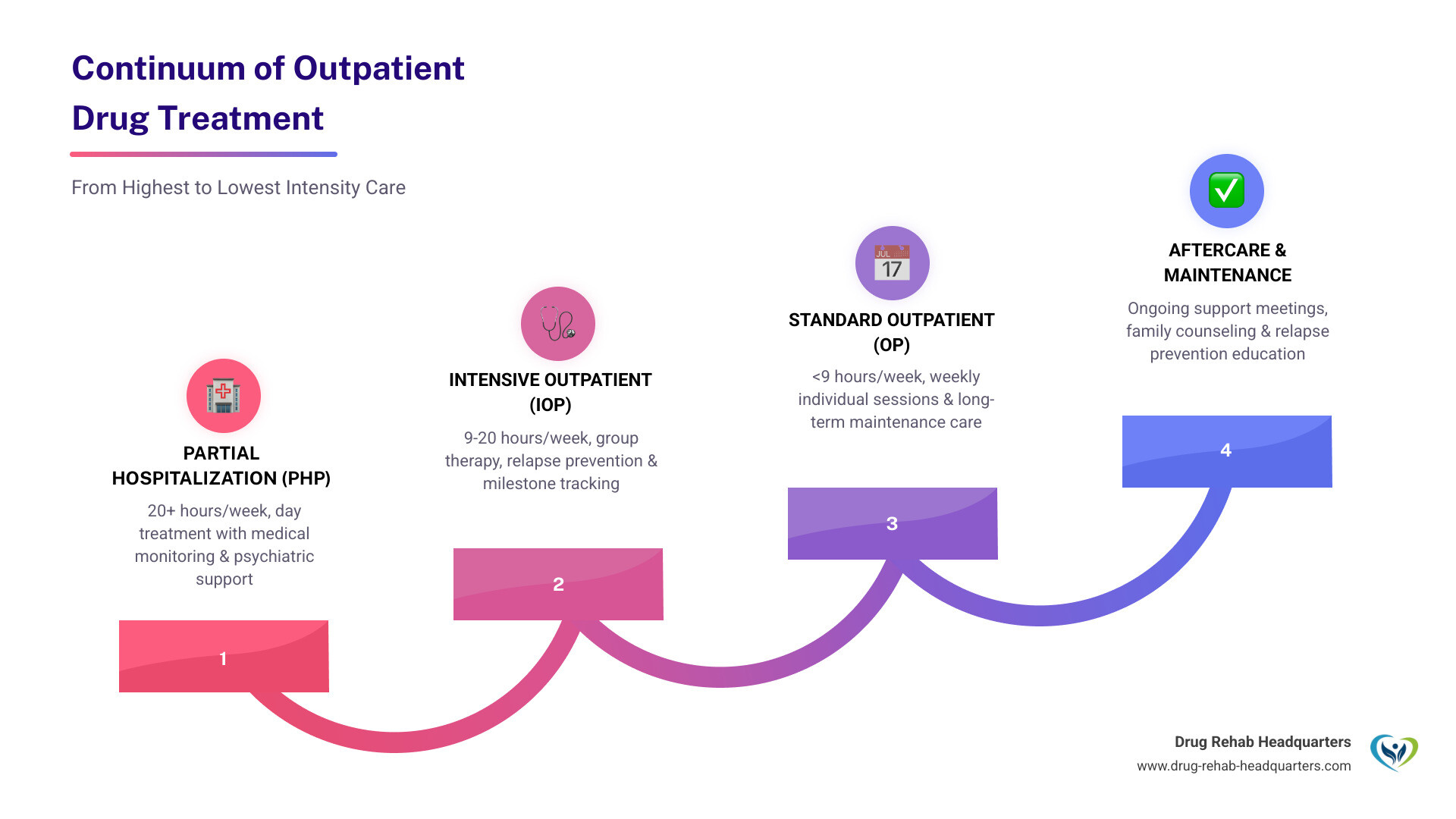
Not all outpatient programs are created equal. They exist on a spectrum of intensity, often categorized by the American Society of Addiction Medicine (ASAM) levels of care. As you progress in your recovery, you might “step down” from a high-intensity program to a lower-intensity one. This ensures you have a safety net while you gradually regain full independence.
Partial Hospitalization Programs (PHP)
PHPs, often called “day treatment,” are the most intensive form of Outpatient Drug Treatment. These programs typically require a commitment of 20 or more hours per week, often meeting 5 to 7 days a week for several hours each day.
PHPs are designed for those who need significant medical and psychiatric monitoring but have a stable enough home environment to stay safe overnight. You’ll receive a high level of clinical care, including frequent meetings with medical doctors and intensive group therapy sessions. In terms of cost, private pay rates for PHP typically range from $350 to $450 per day.
Intensive Outpatient Programs (IOP)
An intensive outpatient treatment program is often the “sweet spot” for many in recovery. These programs usually require 9 to 20 hours of structured programming per week, often delivered in 3-hour sessions held 3 to 5 times a week.
IOPs focus heavily on group therapy, relapse prevention, and milestone tracking. They are ideal for individuals transitioning out of inpatient care or for those whose addiction is moderate but requires more than once-a-week counseling. The cost for intensive outpatient care usually falls between $250 and $350 per day for private pay.
Standard Outpatient Drug Treatment
Standard Outpatient Programs (OP) are the least restrictive level of care, requiring fewer than 9 hours of service per week. Often, this involves 1 to 2 sessions per week. This level of care is excellent for maintenance and long-term support once the initial crisis of addiction has passed. It allows you to keep a full-time job or school schedule while still checking in with a therapist and a support group to stay on track.
Benefits and Costs of Outpatient Care
Choosing Outpatient Drug Treatment offers several distinct advantages, particularly for those who cannot afford to leave their lives behind for a month or more.
- Flexibility: You can maintain your career, education, and family roles. Many programs offer evening and weekend sessions to accommodate busy schedules.
- Affordability: Because you aren’t paying for room and board, the price tag is significantly lower than inpatient care. A 1–3 month outpatient program typically costs between $2,000 and $5,500, whereas inpatient care can cost $500–$650 per day.
- Real-World Practice: You can practice your sobriety skills in real-time. If you face a trigger at home, you can bring that experience to your therapy session the next day.
- Family Support: You remain close to your loved ones, who can often participate in family therapy sessions to help heal the entire family unit.
- Privacy: You don’t have to explain a month-long absence to your employer or neighbors.
For those who need a quicker but effective intervention, short term rehab options often utilize outpatient structures to provide rapid stabilization.
Choosing the Right Outpatient Drug Treatment
While the benefits are great, outpatient care isn’t for everyone. It requires a specific set of circumstances to be successful. You might be a good candidate if:
- Your addiction is in the mild to moderate range.
- You have already completed a medical detox (if necessary).
- Your home environment is stable, drug-free, and supportive.
- You have reliable transportation to attend all sessions.
- You are highly motivated and have the self-discipline to avoid triggers without 24/7 supervision.
If you are unsure, check out these 7 ways to know if outpatient drug treatment is right for you for a deeper dive into the candidacy requirements.
Best Alcohol Rehab Centers: Inpatient vs. Outpatient
When looking for the best alcohol rehab centers, understand the structural differences between inpatient and outpatient care. While studies suggest that outpatient rehab can be just as effective as inpatient rehab for many, the “drop-out” rate is often higher in outpatient settings because the temptation to use is more accessible.
| Feature | Inpatient / Residential | Outpatient Treatment |
|---|---|---|
| Living Arrangements | Live at the facility | Live at home or sober living |
| Supervision | 24/7 medical & clinical care | Scheduled sessions only |
| Environment | Controlled, trigger-free | Real-world environment |
| Time Commitment | Full-time (30-90 days) | 9-30 hours per week |
| Cost | Higher ($15k – $50k+ per month) | Lower ($2k – $10k per program) |
| Completion Rates | 3x more likely to complete | Higher risk of drop-out |
Residential and Inpatient Alcohol Treatment Centers
For those with severe, long-term addictions or co-occurring mental health disorders, residential alcohol treatment centers are often the safest starting point. These facilities provide an immersive environment where the only focus is healing. They offer medical detox to manage dangerous withdrawal symptoms and provide a “buffer” from the people, places, and things that trigger the urge to use. Once a patient is stabilized in an inpatient setting, they almost always transition into an outpatient program to continue their journey.
Services and Therapies in Outpatient Programs
Modern Outpatient Drug Treatment is far more than just “sitting in a circle and talking.” It utilizes a variety of evidence-based behavioral therapies designed to rewire the brain’s response to addiction. According to research on outpatient service requirements, programs must offer at least nine hours of service per week to be considered “intensive,” and these hours are packed with diverse treatments.
- Cognitive Behavioral Therapy (CBT): Helps you identify and change the thought patterns that lead to drug use.
- Dialectical Behavior Therapy (DBT): Focuses on emotional regulation and mindfulness.
- Medication-Assisted Treatment (MAT): The use of FDA-approved medications (like Suboxone, Vivitrol, or Methadone) to reduce cravings and manage withdrawal symptoms.
- Family Counseling: Repairs the relationships damaged by addiction and teaches family members how to support recovery without enabling.
- Contingency Management: Uses positive reinforcement (like small rewards) to encourage sobriety and session attendance.
- Case Management: Helps you navigate legal issues, find employment, or secure stable housing—addressing the “social determinants” of health.
Frequently Asked Questions about Outpatient Rehab
How long does outpatient treatment usually last?
There is no “one-size-fits-all” timeline. Most standard programs last between 8 to 16 weeks, but many people stay involved in some form of outpatient care for a year or longer. Research shows that staying in treatment for at least 90 days significantly improves the chances of long-term sobriety.
Does insurance cover the cost of outpatient rehab?
Yes, in most cases. Thanks to the Affordable Care Act (ACA) and Mental Health Parity laws, insurance providers are required to cover substance use treatment similarly to how they cover other medical procedures. Whether you have private insurance (like Blue Cross, Aetna, or Cigna), Medicaid, or Medicare, some or all of your outpatient costs are likely covered. At Drug Rehab Headquarters, we can help you verify your benefits for free.
What happens if I relapse during an outpatient program?
Relapse is often a part of the recovery journey, not a sign of failure. If you relapse while in an outpatient program, your care team will reassess your needs. This might involve increasing the frequency of your sessions, switching to a more intensive level of care (like moving from IOP to PHP), or temporarily entering an inpatient facility for stabilization.
Conclusion
Recovery is a marathon, not a sprint, and Outpatient Drug Treatment provides the endurance training you need to succeed in the long run. By offering a blend of professional medical care, evidence-based therapy, and the flexibility to live your life, these programs make recovery accessible to everyone.
At Drug Rehab Headquarters, we understand that every recovery journey is unique. Whether you are looking for a high-intensity PHP in Texas or a flexible evening IOP in Florida, we are here to help. Our certified counselors—many of whom have walked this path themselves—are available 24/7 to provide free, personalized guidance. We can help you find evidence-based drug addiction treatment that fits your budget, your schedule, and your life.
You don’t have to do this alone. Reach out to us today, and let’s take that first step toward a healthier, sober future together.