
Why Behavioral Therapy for Addiction Is the Foundation of Lasting Recovery
Behavioral therapy for addiction is a proven, evidence-based approach that helps people break the cycle of substance use by changing the thoughts, emotions, and behaviors that drive it.
Here is a quick overview of the main types:
| Therapy Type | What It Does | Best For |
|---|---|---|
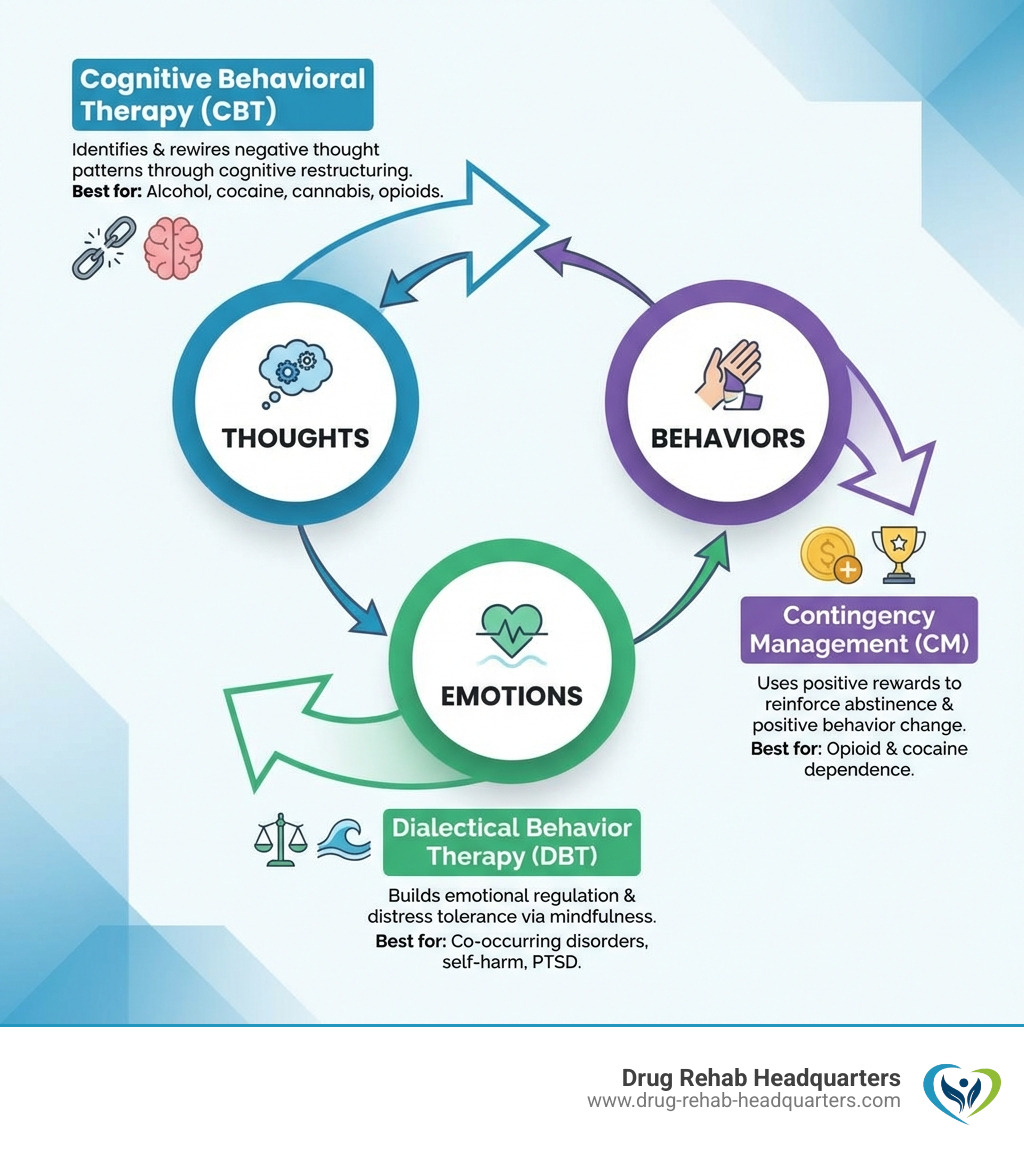
| Cognitive Behavioral Therapy (CBT) | Identifies and rewires negative thought patterns | Alcohol, cocaine, cannabis, opioids |
| Dialectical Behavior Therapy (DBT) | Builds emotional regulation and distress tolerance | Co-occurring disorders, self-harm, PTSD |
| Motivational Interviewing (MI) | Strengthens personal motivation to change | Early-stage or ambivalent patients |
| Contingency Management (CM) | Uses positive rewards to reinforce abstinence | Opioid and cocaine dependence |
| Relapse Prevention (RP) | Teaches coping skills to avoid future use | Long-term recovery support |
Addiction is not simply a matter of willpower. Research consistently shows that substance use rewires how the brain responds to stress, pleasure, and decision-making. Behavioral therapies work with that biology — helping people learn new patterns instead of fighting old ones alone.
The stakes are high. Lifetime rates of substance use disorders affect more than 30% of people for alcohol and over 10% for other drugs. Yet effective, structured treatment exists — and behavioral therapy is at the center of it.
Whether you are looking at drug treatment centers, inpatient rehab programs, or outpatient counseling, behavioral therapy is almost always part of the plan. And for good reason: a meta-analysis of 34 clinical trials found that CBT alone produced a meaningful effect (d = 0.45) across substance use disorders — with even stronger results for cannabis and cocaine.
At Drug Rehab Headquarters, we have spent years helping individuals and families find the right evidence-based treatment — including programs built around behavioral therapy for addiction — cutting through the confusion so people can focus on recovery. If you need guidance right now, call us at (866) 720-3784 — we are ready to help you find the right path forward.
Understanding Behavioral Therapy for Addiction
To understand how behavioral therapy for addiction works, we have to look at its roots. Modern behavioral therapy isn’t just about “talking through your feelings.” It is a highly structured, goal-oriented system designed to tackle the mechanics of how we function.
In the 1960s, a psychiatrist named Dr. Aaron Beck changed mental health. While working with patients struggling with depression, he noticed they often had “automatic thoughts”—logical fallacies that fueled their low mood. He realized that if you could help a person identify and challenge these illogical thoughts, their mood and behavior would follow suit. This was the birth of Cognitive Behavioral Therapy (CBT).

The CBT model operates on a simple but powerful triangle:
- Thoughts: What we think affects how we feel and act.
- Emotions: How we feel affects what we think and do.
- Behaviors: What we do affects how we think and feel.
In the context of addiction, this cycle often looks like this: “I can’t handle this stress (Thought) -> Anxiety and desperation (Emotion) -> Using a substance to numb out (Behavior).” Behavioral therapy interrupts this loop at every corner. You can dive deeper into these origins here: Scientific research on the origins of CBT.
If you feel trapped in this cycle, you don’t have to break it alone. Our counselors at Drug Rehab Headquarters are available 24/7 at (866) 720-3784 to help you find a program that uses these exact methods to help you regain control.
Core Principles of Behavioral Change
The primary goal of behavioral therapy for addiction is to help a person recognize that their substance use is a learned behavior that can be unlearned. We use several core principles to make this happen:
- Functional Analysis: This is the detective work of therapy. We look at the “antecedents” (what happens before you use) and the “consequences” (what happens after). By understanding the motives for drug use—whether it’s to escape pain, fit in socially, or manage a panic disorder—we can build a targeted plan.
- Skill-Building: Many people use substances because they lack certain life skills, such as stress management or interpersonal communication. Therapy provides a “toolkit” to handle these situations without a bottle or a pill.
- Addressing Maladaptive Patterns: We work to identify “thinking distortions.” For example, a person might think, “I already messed up and had one drink, so I might as well finish the whole bottle.” Therapy teaches you to catch that thought and reframe it.
To see these principles in action, check out this Video on how CBT works.
Success Rates
We don’t just use these therapies because they sound good; we use them because they work. Scientific reviews have shown that behavioral therapy for addiction has a moderate-to-large effect size across a variety of substances.
- Overall Efficacy: A meta-analytic review of 34 randomized controlled trials involving over 2,300 patients found an overall moderate effect size (d = 0.45) for CBT in treating drug abuse and dependence.
- Cocaine Success: In a landmark study on psychosocial treatment for cocaine dependence, 60% of patients in the CBT condition provided clean toxicology screens at their 52-week follow-up. This shows that the effects of therapy aren’t just a “quick fix”—they last.
- Cannabis and Opioids: Research shows particularly strong results for cannabis recovery and significant improvements for those struggling with opioids when combined with other supports.
You can read the full breakdown of these outcomes here: Research on cocaine dependence outcomes. If these statistics give you hope, give us a call at (866) 720-3784. We can help you find drug rehab centers in your area that specialize in these high-success modalities.
Core Modalities: CBT vs. DBT
When you enter an inpatient rehab or an outpatient program, you will likely encounter two heavy hitters: CBT and DBT. While they share a common ancestor, they have different “personalities.”
| Feature | Cognitive Behavioral Therapy (CBT) | Dialectical Behavior Therapy (DBT) |
|---|---|---|
| Primary Focus | Logic, thoughts, and problem-solving | Emotions, acceptance, and relationships |
| Key Goal | Change irrational thought patterns | Balance change with self-acceptance |
| Timeframe | Short-term (12-20 sessions) | Often longer-term and more intensive |
| Core Skill | Cognitive Restructuring | Mindfulness and Distress Tolerance |
Cognitive Behavioral Therapy for Addiction
CBT is the “practical” therapy. It’s about the here-and-now. In a drug treatment center, a CBT therapist will work with you to identify high-risk situations—like a specific bar, a stressful work meeting, or even a certain “friend”—and develop a plan to navigate them.
One of the most powerful tools in CBT is cognitive restructuring. This involves looking at a thought like “I am a failure and will never get sober” and checking it against the evidence. Is it true? Is it helpful? By replacing these “automatic thoughts” with more balanced ones, the urge to use substances often diminishes. You can explore more on this here: Scientific research on CBT for substance use.
Dialectical Behavioral Therapy for Addiction
DBT was originally developed by Dr. Marsha Linehan to treat severe emotional instability, but it has become a gold standard for behavioral therapy for addiction. The word “dialectical” means the “fusion of opposites.” In DBT, we learn to accept ourselves exactly as we are while simultaneously working hard to change our lives.
DBT is famous for its “distress tolerance” skills. It teaches you how to survive a crisis—like an intense craving—without making things worse. One popular DBT tool is the IMPROVE acronym:
- Imagery (visualizing a safe place)
- Meaning (finding a reason to stay sober)
- Prayer (or meditation)
- Relaxation
- One thing in the moment
- Vacation (a brief mental break)
- Encouragement (positive self-talk)
For more on how these skills keep people sober, see the Research on the effectiveness of DBT. If you’re struggling with intense emotions alongside addiction, call us at (866) 720-3784 to find a program that offers comprehensive DBT.
Proven Techniques Used in Drug Treatment Centers
In the best drug treatment centers, behavioral therapy is more than just sitting on a couch. It involves active, hands-on techniques that have been tested in labs and real-world clinics.
Relapse Prevention (RP) Strategies
Relapse Prevention is a specific type of behavioral therapy for addiction that treats recovery as a skill to be mastered. Instead of viewing a “slip” as a total failure, RP teaches you to see it as a “prolapse”—an opportunity to learn what went wrong and adjust the plan.
Research on 26 studies showed that while RP had a small effect on reducing immediate substance use, it had a large effect (r = .48) on improving overall psychosocial adjustment. This means people in RP programs don’t just stay sober; they actually start enjoying their lives more. Learn more about these strategies here: Research on RP efficacy.
Contingency Management (CM)
Contingency Management is based on the simple principle of positive reinforcement. If you provide a person with a tangible reward for a positive behavior (like a clean drug screen), they are much more likely to repeat that behavior.
CM often uses a “prize draw” or voucher system. Meta-analyses have found that CM is incredibly effective, especially for stimulants like cocaine and methamphetamine, where other medications might be less effective. You can read the data here: Scientific research on Contingency Management.
Community Reinforcement Approach (CRA)
CRA is a comprehensive “lifestyle” version of behavioral therapy. It assumes that if a person’s environment is more rewarding when they are sober than when they are using, they will choose sobriety. This involves working on job skills, social hobbies, and relationship counseling.
The results are impressive. Early studies showed that those in CRA programs had significantly more days of sobriety than those in standard “talk therapy” programs. Dig into the history of CRA here: Scientific research on CRA.
If you want to find a facility that uses these “gold standard” techniques, call Drug Rehab Headquarters at (866) 720-3784. We can help you find an inpatient rehab that fits your specific needs.
Integrating Therapy into Inpatient Rehab Programs
While behavioral therapy is powerful on its own, it works best when it is part of a “whole-person” approach. In an inpatient rehab setting, we can combine therapy with other medical and social supports for the best possible outcome.
Combining Behavioral Therapy with Pharmacotherapy
For many people, the best way to “beat addiction for good” is a combination of medication and therapy. This is often called Medication-Assisted Treatment (MAT).
- Alcohol: Combining medications like Naltrexone or Acamprosate with CBT has been shown to be superior to using medication alone. The therapy helps you handle the triggers, while the medication reduces the physical cravings.
- Opioids: Behavioral therapies help patients stay engaged with medications like Buprenorphine or Methadone, significantly reducing the risk of overdose.
Research suggests that adding behavioral therapy to medical management provides a small but significant boost in outcomes. You can check out the study on combined treatments here: Research on combined treatment efficacy.
The Role of Family and Couples Therapy
Addiction doesn’t happen in a vacuum—it affects everyone in the house. Behavioral Couples Therapy (BCT) is a specialized approach that brings a non-using partner into the recovery process.
BCT focuses on “sobriety contracts” and improving communication. Not only does this help the person struggling with addiction stay sober, but it also improves the mental health of the partner and the children in the home. Meta-analyses show that BCT is often more effective than individual therapy for married or cohabitating individuals. Read more on the family impact here: Scientific research on BCT.
If you want to involve your family in your recovery, call us at (866) 720-3784. We can find drug treatment centers that offer family-focused behavioral programs.
Insurance Coverage for Indiana Rehab Centers
Is behavioral therapy for addiction right for everyone? Generally, yes. Because it is so adaptable, it can be tailored for teens, adults, and seniors. However, it does require a level of active participation. If you are looking for a therapy where you just sit back and let the therapist do all the work, CBT might be a bit of a shock!
Typical Session Structure and Duration
One of the best things about behavioral therapy is that it is time-limited. You aren’t expected to be in therapy for the rest of your life!
- The First Session: This is an evaluation. You will discuss your history, your triggers, and set clear, measurable goals.
- Duration: Most people see significant results in 12 to 20 sessions.
- The Work: Expect homework! You might be asked to keep a “thought record” or try a new coping skill between sessions.
To hear a doctor discuss the role of therapy in treatment, watch this Video on therapy’s role in addiction.
Cost and Insurance Information
Many people worry about the cost of inpatient rehab or specialized therapy. The good news is that under the Affordable Care Act, mental health and substance use services are considered “essential health benefits.”
- Cost of Rehabilitation: In Indiana, the cost of rehabilitation varies depending on the facility and the intensity of the program. Outpatient services are generally more affordable, while residential care includes the cost of housing and 24/7 support.
- Private Insurance: Most plans cover behavioral therapy with parity to medical services.
- Medicare and Medicaid: In Indiana, both cover evidence-based behavioral therapies for addiction.
If you need help finding a provider in your area who accepts your specific insurance, click here: Find a provider who accepts Medicare/Medicaid. Or, save time and call us at (866) 720-3784—we can verify your insurance benefits for you for free.
Self-Help and Computer-Based Options
We know that getting to a clinic every week isn’t always possible. Fortunately, technology is making behavioral therapy for addiction more accessible.
Programs like CBT4CBT (Computer-Based Training for CBT) allow individuals to learn core skills through interactive movies and exercises. Research has shown that adding computer-based CBT to standard counseling significantly increases the number of drug-free urines and the duration of abstinence. You can read about the effectiveness of digital CBT here: Scientific research on computer-assisted CBT.
Frequently Asked Questions about Behavioral Therapy
Who is behavioral therapy most suitable for?
It is a great fit for anyone who wants practical, action-oriented tools. It is especially effective for those who are also dealing with anxiety, depression, or PTSD. It may not be the best fit for someone who is currently in an active state of psychosis or someone who is not yet ready to participate in “homework” or skill practice.
How long does it take to see results?
While every person is different, many people report feeling more in control after just 4 to 6 sessions. The full course of treatment usually lasts a few months, providing long-term skills that help prevent future relapses.
Can I use behavioral therapy for both alcohol and drugs?
Absolutely. The core principles—identifying triggers, changing thoughts, and reinforcing positive behaviors—are the same whether you are struggling with alcohol, opioids, stimulants, or cannabis.
Conclusion
Recovery is a journey, but you don’t have to walk it without a map. Behavioral therapy for addiction provides the tools, the structure, and the evidence-based strategies to help you rebuild your life from the ground up. Whether it’s through cognitive restructuring in CBT or building distress tolerance in DBT, these methods have helped millions of people find their way back to health.
At Drug Rehab Headquarters, we are committed to connecting you with the highest quality care in North America. Our certified counselors—many of whom have their own lived experience—are standing by 24/7 to provide personalized, confidential guidance.
Don’t let another day go by feeling stuck. Whether you need an inpatient rehab program, a local drug treatment center, or just someone to talk to, we are here.
Call us now at (866) 720-3784 to start your recovery journey today.
Types of Rehab Centers in Indiana
Indiana provides a wide range of options for those seeking help. Drug rehab centers in the state range from intensive detoxification units to long-term residential facilities. Some centers specialize in dual diagnosis, treating both addiction and mental health disorders like depression or anxiety, while others focus on specific populations, such as veterans or adolescents. These rehabilitation centers utilize evidence-based behavioral therapies to ensure patients have the best chance at a successful recovery.
Inpatient vs. Outpatient Treatment in Indiana
When choosing a path to recovery, it is important to understand the difference between inpatient rehab and outpatient care. Inpatient rehab in Indiana offers a highly structured environment where patients live at the facility. This is often recommended for those with severe addictions or unstable home environments. Conversely, outpatient treatment allows individuals to attend therapy sessions during the day and return home at night. This form of rehabilitation is ideal for those who have completed a residential program or have strong support systems in place.
Finding the Right Addiction Treatment Program
Finding the right program is a critical step in the journey to sobriety. It is essential to look for drug rehab centers that prioritize evidence-based practices like behavioral therapy for addiction. When evaluating a program, ask about their success rates, the qualifications of their staff, and whether they offer personalized treatment plans. A high-quality rehabilitation program will not only treat the physical symptoms of addiction but also provide the psychological tools needed for long-term health. For assistance in navigating these choices, contact Drug Rehab Headquarters at (866) 720-3784.