
Understanding Community Medical Center Billing: Your First Step to Financial Clarity
Community medical center billing can feel overwhelming, but managing it doesn’t have to be complicated. Here’s what you need to know:
Quick Guide to Managing Your Medical Bills:
- Payment Options – Pay online through MyHealthMate or MyChart, by phone at (559) 459-3939, by mail, or in-person at the cashier’s desk
- Multiple Bills Are Normal – Expect separate statements from the hospital, your physician, radiologists, anesthesiologists, and other specialists
- Insurance Processing Takes Time – Most insurance companies settle accounts within 45 days of billing
- Financial Help Is Available – Payment plans with 0% APR, sliding scale options, and financial assistance programs exist for those who qualify
- Cost Estimates Are Possible – Use the Cost Estimator tool or call Patient Pre-Registration at (559) 459-5734 before your procedure
Medical bills arrive when you’re already dealing with health concerns. The statements use confusing terms like “adjustment” and “co-insurance.” You might receive bills from multiple providers for a single visit. Your insurance explanation doesn’t match what the hospital charged. And if you’re seeking addiction treatment or mental health services, community medical center billing adds another layer of stress to an already difficult journey.
The good news? Community medical centers have created clearer systems for managing payments, understanding costs, and getting financial support when you need it most.
At Drug Rehab Headquarters, we’ve guided countless individuals and families through the complexities of treatment services, including navigating community medical center billing for addiction and mental health care. We know that understanding your financial options is crucial to accessing the help you or your loved one needs.
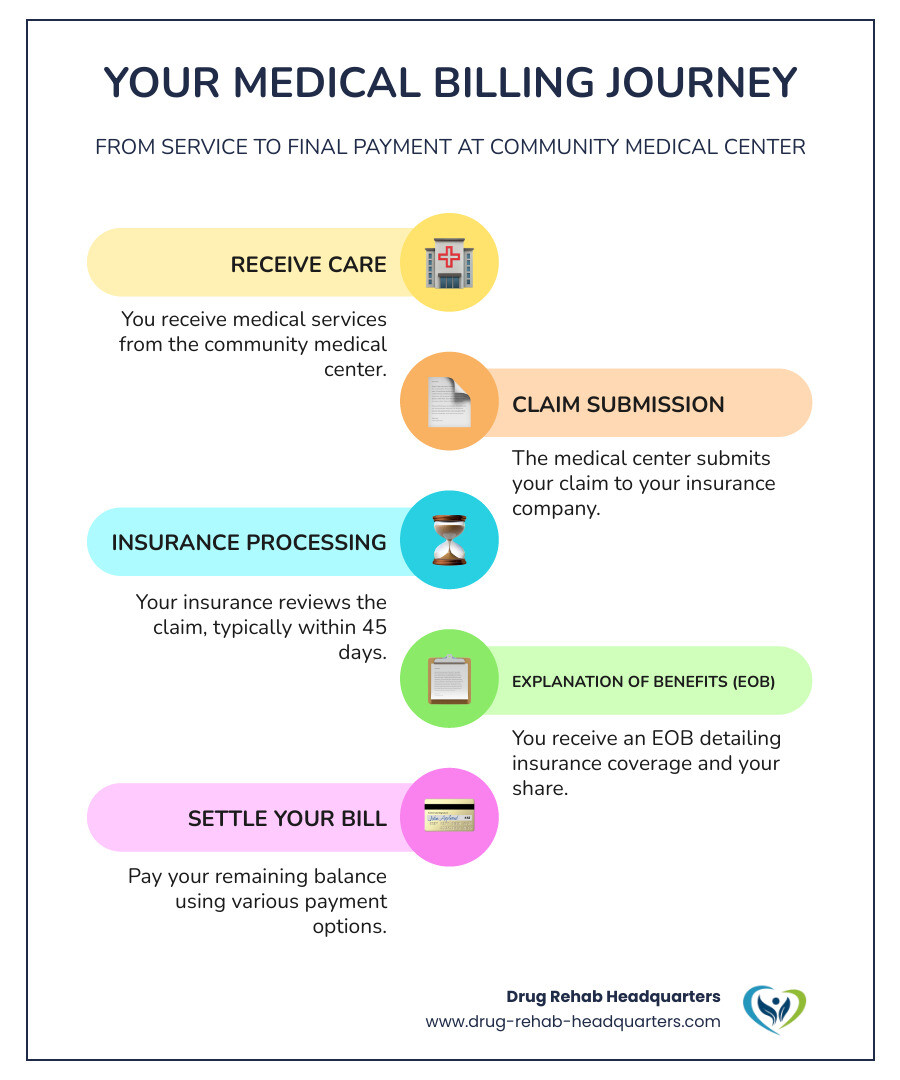
Understanding Your Bill and Insurance
Navigating medical bills can feel like deciphering a foreign language. A common point of confusion is receiving multiple bills for a single visit. It’s also vital to understand your insurance, especially for emergency or out-of-network situations. Community medical centers strive for transparency, offering tools and support to help you understand your financial responsibilities.

What’s the difference between a hospital bill and a physician bill?
Receiving several different bills for one hospital visit is common, but there’s a logical reason for it. Your hospital bill covers “facility fees” for the room, equipment, nursing staff, medications, and lab tests.
However, many doctors who treat you in the hospital are independent practitioners, not hospital employees. They have “staff privileges” to work there but bill for their services separately. For example, after surgery, you might get separate physician bills from the surgeon, anesthesiologist, and radiologist. These cover their professional fees for their expertise and time.
While it can be overwhelming, each statement covers a different part of your care: either facility fees or professional services. For questions about a specific bill, contact the billing department listed on that statement.
How does insurance work, especially for out-of-network care?
Understanding your insurance is key to managing healthcare costs. Community medical centers accept many insurance plans. An “in-network” center has a contract with your insurer for discounted rates, which means lower out-of-pocket costs for you.
Your insurance plan will usually involve several key terms:
- Deductible: The amount you must pay out-of-pocket for covered services before your insurance starts to pay.
- Co-payment (Co-pay): A fixed amount you pay for a covered service, often at the time of service (e.g., $100 for an emergency visit).
- Co-insurance: A percentage of the cost of a covered service you pay after meeting your deductible. If your co-insurance is 20%, you pay 20% and your insurance pays 80%.
- Out-of-pocket maximum: The most you have to pay for covered services in a plan year. After you reach this amount, your plan pays 100% of covered benefits.
If you use an “out-of-network” provider (one without a contract with your insurer), you will be billed for all services and likely pay a higher percentage of the costs, or even the full amount, until your deductible is met.
For emergencies, the No Surprises Act provides protection. If you get emergency services from an out-of-network provider, the most they may bill you is your plan’s in-network cost-sharing amount (like copayments). This protects you from unexpected bills. For more information, review resources on the No Surprises Act. The Emergency Medical Treatment & Labor Act (EMTALA) also ensures emergency rooms must treat patients before discussing payment.
For specific questions about your coverage, benefits, and deductibles, always contact your insurance carrier directly for the most accurate information.
How can I get an estimate for my procedure?
To avoid surprises with medical bills, many community medical centers offer resources to estimate your costs before a procedure. This proactive step can reduce financial stress and help you plan.
One excellent resource is a Cost Estimator tool, often on the medical center’s website. It lets you search for services and get an out-of-pocket cost estimate based on your health plan, which is invaluable for planning scheduled procedures.
For the most accurate estimate, contact your insurance carrier before any scheduled procedure. They can detail your benefits, deductibles, and coverage. A hospital’s Patient Pre-Registration line, like (559) 459-5734 for Community Medical Centers in California, can also provide a general estimate. Estimates are not guarantees, as actual costs may vary based on the specifics of your care.
Your Guide to Community Medical Center Billing and Payments
When it comes to paying your medical bills, convenience and flexibility are key. Community medical centers recognize this and offer a variety of ways to settle your account, ensuring that you can choose the method that best suits your needs. From online portals to traditional mail, they aim to make the payment process as straightforward as possible.
What are the different ways I can pay my bill?
Community medical centers offer several convenient ways to pay your bill, catering to different preferences and situations. We encourage you to choose the method that works best for you:
- Online Portal: This is often the quickest and most convenient method. You can typically pay online via credit card through a secure portal. Many centers also offer a “guest pay” option, allowing you to pay without logging into an account.
- Pay by Phone: If you prefer to speak with someone or have questions while paying, you can call the Hospital Billing Customer Service. For example, Patient Financial Services at Community Medical Centers in California can be reached at (559) 459-3939 or (800) 773-2223 ext. 53939. Hours are typically Monday through Friday.
- Pay by Mail: For those who prefer traditional methods, you can mail your payment. A common mailing address for Community Medical Centers is PO Box 884428, Los Angeles, CA 90088-4428. Always double-check the specific mailing address on your billing statement.
- In-Person Cashier: If you’re near a Community Medical Center, you might be able to pay in person at the cashier’s desk in the main hospital lobby. Hours vary, but are often Monday through Friday during business hours.
- SMS Text Notifications: Some Community Medical Centers now offer SMS text messaging for bill pay. You can receive estimates, statements, pay your bills, or schedule a payment plan right from your phone. You usually need to opt-in by texting “START” to a designated number (e.g., 21508) or by requesting this service at your next appointment.
Here’s a quick comparison of popular payment options:
| Payment Method | Convenience | Speed | Required Info | Benefits |
|---|---|---|---|---|
| Online Portal | High | Instant | Account/Bill # | 24/7 access, record keeping |
| Phone | Medium | Immediate | Bill #, Payment Info | Personal assistance, questions answered |
| Low | Slow | Bill Stub, Check | Traditional, no internet needed | |
| In-Person | Medium | Immediate | Bill, Payment | Cash accepted, direct interaction |
| SMS Text | High | Instant | Bill #, Payment Info | On-the-go, quick notifications |
How does the online bill pay system work?
The online bill pay system at many community medical centers is designed for ease of use and efficiency. It often revolves around patient portals like MyChart and dedicated apps like MyHealthMate.
If you have an active MyChart account, you are typically automatically enrolled in paperless billing. This is a secure, convenient, and eco-friendly way to view and pay your bills online, as well as manage other aspects of your health. You’ll receive notifications when a new bill is available, and you can access your statements and make payments directly through the MyChart portal on your computer or mobile device.
For those who prefer using a mobile app, Community’s MyHealthMate app provides another avenue. You can sign into the MyHealthMate app to view and pay your bill, either as a registered user (linked to your MyChart account) or as a guest. This flexibility ensures that even if you don’t have a MyChart account or simply need to make a quick payment, you can do so easily. To pay as a guest, you usually just need your account number and date of birth. You can access the guest payment portal directly at Pay as guest.
The benefits of using these online systems are numerous:
- Convenience: Pay your bills anytime, anywhere, 24/7.
- Security: Your financial information is protected through secure online platforms.
- Eco-friendly: Reduce paper waste by opting for paperless statements.
- Accessibility: View your billing history and statements at your convenience.
How can I get an itemized statement of my charges?
Sometimes, you might want a detailed breakdown of all the services and charges on your bill. This is where an itemized statement comes in. You can generally request an itemized statement by calling the Hospital Billing Customer Service or Patient Financial Services at your community medical center. For example, at some Community Medical Centers, you can call (559) 459-3939 or (800) 773-2223 ext. 53939.
However, it’s important to understand that an itemized statement may sometimes be of limited use in understanding your ultimate financial responsibility. This is because the amount you owe as a patient is rarely based on the total charges listed. Instead, it’s typically based on a reduced rate that your insurance company and the hospital have already negotiated. This “adjustment” (which we’ll discuss more later) means that the full, unadjusted charges on an itemized statement might not directly reflect what you or your insurance company will actually pay.
Nevertheless, if you need one for your records or for clarification, don’t hesitate to request it. The billing department can provide it upon request and help you understand the charges.
Options When You Need Financial Support
We understand that medical bills can be a significant financial burden, especially when dealing with addiction or mental health care costs. Community medical centers are committed to ensuring care is accessible, regardless of your ability to pay, and offer various programs to provide financial relief.

What if I need more time to pay my bill?
If you need more time to pay your bill, many community medical centers offer flexible payment solutions.
A common option is a payment plan, which allows for manageable monthly payments. For instance, Community Medical Center partners with CarePayment to offer 0.00% APR payment options. CarePayment is not a collection agency and won’t affect your credit rating. Contact them at 866-625-8532 or register online at CarePayment program. Another example is the Health Services Financing program at Commerce Bank for Community Health Network patients, which offers easy enrollment and spreads payments over time.
To explore these options, contact your medical center’s Patient Financial Services department. They can help you set up a payment plan that fits your budget. Their contact information is usually on your bill.
How does the community medical center billing process handle patients with no insurance?
Community medical centers are committed to providing care regardless of insurance status, offering free and discounted services to families in need. Access to critical services like addiction and mental health treatment should not be dictated by ability to pay.
For patients without insurance, several options are typically available:
- Free and Discounted Care: Many centers offer programs with free or discounted services based on financial need.
- Financial Assistance Programs (Charity Care): These programs help those with financial hardship who don’t qualify for other coverage (like Medicaid) and meet income/household size guidelines.
- Sliding Scale Programs: Some hospitals, like Community Hospital in Colorado, offer a hospital-funded Sliding Scale Program. It often has no residency requirements, and the amount you pay depends on your approved income level.
- Government Programs: You may qualify for programs like Medicaid, Medicare, or state exchanges (e.g., Covered California). Medical centers can often help with these applications.
Community Hospital in Colorado, for example, provides emergency care to all individuals without discrimination, regardless of their ability to pay, ensuring urgent needs are met.
What is the process for applying for financial assistance?
Applying for financial assistance can feel daunting, but medical centers have staff to guide you. The goal is to help those with significant financial strain.
Eligibility Criteria: Criteria vary, but assistance is generally for those with financial hardship who don’t qualify for other coverage. Some programs have minimum balance requirements, like the $250 hospital balance at Community Hospital in Colorado.
Application Process:
- Get an Application: Download the application from the hospital’s website or request it from Patient Financial Services. For example, Community Hospital in Colorado’s application is available online: Financial Assistance Application.
- Gather Required Documents: You’ll need to provide documents to verify income, household size, and residency. These often include:
- Completed financial assistance application.
- Valid photo identification for each adult in the household.
- Birth certificates for all children under 18.
- Social Security cards for each family member.
- Copies of all health insurance cards (front and back).
- Medicaid and/or CHP+ denial letters for any family member who may be eligible.
- Copies of personal and business checking and savings bank statements.
- Copies of all income sources for the past 30 days (e.g., pay stubs, unemployment benefits, Social Security statements).
- Copies of your last two federal tax returns (if applicable).
- Mortgage or rent agreement.
- Submit the Application: Submit the completed application and documents within the specified timeframe (e.g., 14 days from your bill date).
- Review and Approval: The center will review your application to determine eligibility and may contact you for more information.
The Colorado Indigent Care Program (CICP) is a state-sponsored program for Colorado residents who can establish lawful presence. Qualifying for CICP may automatically qualify you for a hospital’s sliding scale program.
Continue making payments on any existing plan while you apply. Financial assistance is not insurance and is not accepted by other providers. For help, call the financial assistance department, such as 406-282-4085 for a Community Medical Center in Montana.
Frequently Asked Questions about Community Medical Center Billing
Even with all the information available, questions about medical billing are common. Here, we address some of the most frequently asked questions to help explain the process and give you confidence in managing your healthcare finances.
Why do I have to give my insurance information again at the hospital?
It can be frustrating when you’ve already provided your insurance details to your doctor’s office, only to be asked for them again at the hospital. This often happens because physicians and hospitals maintain separate health insurance information. Here’s why:
- Separate Entities: As we discussed, many doctors (like radiologists, anesthesiologists, or even your surgeon) are independent practitioners, not direct employees of the hospital. They have their own billing systems and need your insurance information for their claims.
- Different Coverage: Your insurance coverage might differ for physician visits versus hospital services. What your plan covers for an outpatient visit might be different from what it covers for an inpatient stay or emergency room services.
- Accuracy and Updates: Providing your information again ensures that the hospital has the most current and accurate insurance details for their billing process. Insurance plans can change, and confirming your information helps prevent delays or denials.
While it may seem redundant, this process helps ensure that both the hospital and the individual providers can accurately bill your insurance for the services rendered.
What is an “adjustment” on my bill?
When you look at your medical bill, you might notice a line item called “adjustment.” This can be confusing, as it often appears as a significant reduction from the total charges. An adjustment refers to a discount that your insurance company and the hospital or doctor have agreed to “write off.”
Here’s how it works:
- Total Charges: This is the full, undiscounted amount the hospital or doctor charges for a service.
- Negotiated Rate: Your insurance company has a contract with the medical center. This contract specifies a lower, “negotiated rate” for services.
- Adjustment: The difference between the total charges and the negotiated rate is the adjustment. The medical center agrees not to collect this amount from you or your insurance. It’s essentially a contractual discount.
So, if a hospital charges $10,000 for a procedure, but the negotiated rate with your insurance is $2,500, then $7,500 would be shown as an adjustment. You would then be responsible for your co-payment, co-insurance, or deductible based on the $2,500 negotiated rate, not the original $10,000. This is why an itemized statement showing only total charges can be misleading if you don’t understand the role of adjustments.
What is MyHealthMate and how does it help manage my health and bills?
MyHealthMate is an invaluable tool offered by Community Medical Centers, designed to empower patients in managing both their health information and their billing. It’s essentially an electronic health record system that provides secure online access to various aspects of your care.
Here’s how MyHealthMate can help you:
- View and Pay Bills: This is a primary function, allowing you to view your current and past billing statements and make payments online, either by logging in or as a guest. You can access the login portal at Log in to MyHealthMate.
- Access Medical Information: You can view your health summaries, test results, and even request prescription refills.
- Manage Appointments: It allows you to request and view upcoming appointments, helping you stay organized with your healthcare journey.
- Communicate with Your Doctor: MyHealthMate often includes secure messaging features, enabling you to communicate directly with your healthcare providers.
MyHealthMate, often integrated with or serving as a mobile extension of MyChart, aims to provide a comprehensive, convenient, and secure platform for managing your healthcare logistics. If you have questions about MyHealthMate, you can contact MyChart Support at (559) 459-4142 or email [email protected].
Conclusion
Navigating community medical center billing can certainly feel like a complex journey, but with the right information and resources, it becomes much more manageable. We’ve explored the various payment methods, the nuances of insurance coverage, and the crucial financial assistance programs available to ensure that your focus can remain on your health and recovery.
Remember these key takeaways:
- Proactive Communication is Key: Don’t hesitate to reach out to Patient Financial Services or your insurance provider with any questions before or after receiving care.
- Use Available Tools: Online portals like MyHealthMate and Cost Estimator tools are designed to empower you with information and convenience.
- Financial Support Exists: Whether through payment plans, charity care, or government programs, community medical centers are dedicated to helping you access necessary care regardless of your financial situation.
At Drug Rehab Headquarters, we understand that managing the logistics of healthcare, especially when seeking addiction or mental health treatment, can be overwhelming. Our mission is to provide 24/7 free support from certified counselors, many with lived experience, offering personalized guidance to find suitable, evidence-based, holistic treatment options across North America. Understanding your billing and payment options is a vital step in that journey.
If you or a loved one is seeking support for addiction or mental health, we encourage you to reach out. For more information about rehabilitation services and how we can help you find the right path to recovery, please visit our website: More info about rehabilitation services. We’re here to help you every step of the way.