
Understanding Medicaid Coverage for Addiction Treatment
Does Medicaid cover rehab? Yes, Medicaid covers substance use disorder treatment as an essential health benefit under the Affordable Care Act. This includes detoxification services, inpatient and outpatient programs, medication-assisted treatment (MAT), counseling, and behavioral therapy. However, the exact services covered and eligibility requirements vary significantly by state.
Quick Answer: What Medicaid Covers for Rehab (Call (866) 720-3784 for verification)
- Medical Detox – Medically supervised withdrawal management
- Inpatient/Residential Treatment – 24/7 care in a structured facility (when medically necessary)
- Outpatient Programs – Intensive outpatient (IOP) and partial hospitalization (PHP)
- Medication-Assisted Treatment (MAT) – Medications like methadone, Suboxone, and naltrexone plus counseling
- Behavioral Therapy – Individual and group counseling sessions
- Dual Diagnosis Treatment – Integrated care for co-occurring mental health conditions
Important: Coverage specifics depend on your state’s Medicaid program and whether the facility accepts Medicaid. Prior authorization may be required for certain services like residential treatment.
If you’re facing addiction and worried about the cost of treatment, you’re not alone. Nearly 12% of Medicaid enrollees over 18 have a diagnosed substance use disorder, and Medicaid covers as much as 40% of individuals with opioid use disorder. Financial barriers should never prevent someone from getting the help they need.
The good news? Medicaid is the largest single source of funding for mental health and substance use disorder treatment in the United States. Since the Affordable Care Act made addiction treatment an essential health benefit, millions of low-income Americans now have access to recovery services that were previously out of reach.
The challenge? Navigating what’s covered, confirming your eligibility, finding a facility that accepts Medicaid, and understanding the approval process can feel overwhelming when you’re already struggling.
At Drug Rehab Headquarters, we’ve helped thousands of individuals and families understand their insurance benefits and connect with quality treatment options. We know how confusing it can be to answer “Does Medicaid cover rehab” when every state has different rules and requirements. This guide breaks down everything you need to know to use your Medicaid benefits for addiction treatment and start your recovery journey today. If you need immediate help, call us 24/7 at (866) 720-3784 to speak with a certified counselor who can verify your coverage and connect with appropriate care.
Learn more about Does Medicaid cover rehab:
Does Medicaid cover rehab? Understanding Your Benefits
When people ask us, “Does Medicaid cover rehab?” we like to start with the big picture. Since the passage of the Affordable Care Act (ACA) in 2010, the landscape of addiction treatment has changed dramatically for the better. Under the ACA, substance use disorder (SUD) services are classified as “Essential Health Benefits.” This means that all Medicaid plans—whether they are managed by the state or a private insurance company—must provide coverage for mental health and addiction services.
Furthermore, the Mental Health Parity and Addiction Equity Act (MHPAEA) ensures that insurance providers cannot treat addiction benefits as “lesser” than medical or surgical benefits. If your plan covers unlimited doctor visits for a physical ailment, they generally cannot place arbitrary, strict limits on your visits for addiction counseling.
However, while federal law sets the baseline, Medicaid is a joint federal and state program. This means each state has some “wiggle room” in how they deliver these benefits. For example, while one state might readily cover long-term residential Alcohol Rehabilitation Centers, another might require more extensive “prior authorization” or clinical proof that a lower level of care wouldn’t work first.
To get a clearer picture of how insurance interacts with recovery, you can check out our resource on Does Insurance Cover Rehab?. We also recommend visiting the Substance Abuse and Mental Health Services Administration (SAMHSA) website, which is a goldmine of information for public insurance users. For personalized help understanding your benefits, contact us at (866) 720-3784.
Eligibility Requirements for Alcohol Rehabilitation Centers
Before you can walk through the doors of one of the Best alcohol rehab centers, you have to make sure you qualify for Medicaid. Eligibility is primarily based on your income relative to the Federal Poverty Level (FPL), but other factors like household size, disability status, and pregnancy play a huge role.
In many states that chose to expand Medicaid under the ACA, you are eligible if your household income is at or below 133% (effectively 138% with a standard income disregard) of the FPL. For a single person in 2023, the FPL was roughly $14,580, while for a family of four, it was about $30,000.
Let’s look at a specific example. As of late 2022, a single-person household in Nevada could not exceed an annual income of $18,075 to be eligible for Nevada Medicaid. For every additional person in the household, that limit increased by $6,277. Knowing these numbers is vital because even if you were denied in the past, a change in income or household size could make you eligible now. You can dive deeper into the financial side of things by reading about the Cost of Rehab or checking the current U.S. Federal Poverty Guidelines.
Does Medicaid cover rehab for low-income adults and families?
The short answer is a resounding yes. Medicaid was designed specifically to catch those who might otherwise fall through the cracks of the healthcare system. Beyond the standard income limits, several groups are often automatically or more easily eligible:
- Pregnant Women: In almost every state, pregnant women have higher income thresholds for eligibility to ensure both mother and baby receive care.
- SSI Recipients: If you receive Supplemental Security Income (SSI), you are typically eligible for Medicaid.
- Parents and Caretakers: Low-income parents with dependent children often qualify.
- Disability Status: Individuals with documented physical or mental disabilities are a core group served by Medicaid. If you need help determining your eligibility, call (866) 720-3784.
If you aren’t sure where you stand, don’t guess! It’s always better to Verify Insurance or speak with a state caseworker. You can also call us at (866) 720-3784 and we can help you navigate the initial steps of identifying your coverage status.
Services Provided at Medicaid-Approved Alcohol Treatment Centers
Once you’ve cleared the eligibility hurdle, you’ll find that Medicaid-approved Alcohol treatment centers offer a wide range of services designed to treat the whole person, not just the symptoms of use.
Medical Detox
The first step for many is detoxification. Withdrawing from alcohol or certain drugs can be physically dangerous, sometimes even fatal. Medicaid covers medically supervised detox to ensure you stay safe while the toxins leave your body. This usually involves 24/7 monitoring by medical professionals.
Inpatient and Residential Care
For those who need a break from their current environment to focus entirely on healing, inpatient programs provide a structured, trigger-free setting. Medicaid covers these services when they are “medically necessary.” This means a doctor or licensed clinician must evaluate you and determine that you require this level of supervision to succeed.
Outpatient Programs
If you have a stable home environment or work obligations, outpatient Alcohol treatment centers might be the right fit. These include:
- Partial Hospitalization Programs (PHP): High-level care during the day, returning home at night.
- Intensive Outpatient Programs (IOP): Several hours of therapy a few days a week.
- Standard Outpatient: Weekly or bi-weekly counseling sessions.
To see the variety of ways we can help, browse our Treatment Programs page or call (866) 720-3784 for immediate assistance.
Does Medicaid cover rehab for Medication-Assisted Treatment (MAT)?
One of the most effective tools for treating opioid and alcohol use disorders is Medication-Assisted Treatment (MAT). We are happy to report that Medicaid coverage for MAT has expanded significantly. In fact, a 2024 federal extension made MAT coverage a permanent requirement for state Medicaid plans.
Commonly covered medications include:
- Methadone: Used to reduce cravings and withdrawal symptoms for opioid addiction.
- Suboxone (Buprenorphine/Naloxone): Helps manage opioid dependence and can often be prescribed in an office setting.
- Naltrexone (Vivitrol): Used for both opioid and alcohol use disorders to block the “high” and reduce cravings.
Medicaid doesn’t just pay for the pills or injections; it covers the mandatory counseling that must accompany these medications. For more technical details on how this works, you can view the federal guidelines on Opioid Use Disorder Treatment Services or call (866) 720-3784 for more information.
What to expect and success rates in Medicaid programs
When you enter a program funded by Medicaid, you should expect evidence-based care. This isn’t “rehab-lite.” These facilities must meet strict state and federal standards to receive reimbursement. You will undergo a professional clinical assessment to determine your specific needs, and your treatment plan will likely include a mix of individual therapy, group counseling, and medical check-ups.
Success in recovery is often measured by long-term engagement. Statistics show that individuals who complete a full continuum of care—starting with detox and moving through inpatient and then outpatient support—have much higher rates of sustained sobriety. Explore your Treatment Options to see which path aligns with your life.
| Feature | Inpatient Treatment | Outpatient Treatment |
|---|---|---|
| Living Arrangement | On-site at the facility | Live at home |
| Supervision | 24/7 Medical & Clinical | Scheduled sessions only |
| Duration | 30, 60, or 90 days typically | Ongoing, weeks to months |
| Medicaid Coverage | Requires medical necessity | Widely covered |
| Best For | Severe addiction, unstable home | Mild/Moderate addiction, work/family duties |
Navigating Alcohol Rehabilitation Centers in Indiana
If you are looking for help in the Hoosier State, you’ll find that Indiana has a robust system of Alcohol Rehabilitation Centers that accept Medicaid. Indiana Medicaid (often managed through providers like MHS, MDwise, or CareSource) covers a full spectrum of care.
Types of Rehab Centers in Indiana
Indiana offers everything from large hospital-based detox units to smaller, community-based residential homes. Whether you are in Indianapolis, Fort Wayne, or a smaller town like Clarksville, there are options available. For instance, facilities like Avenues Recovery Center at Clarksville provide specialized inpatient care that works closely with Medicaid beneficiaries.
Inpatient vs. Outpatient Treatment in Indiana
In Indiana, the decision between inpatient and outpatient often comes down to the “ASAM Criteria”—a set of guidelines used by clinicians to match you with the right level of care. If you have a high risk of withdrawal or a co-occurring mental health issue, Indiana Medicaid is more likely to approve an inpatient stay.
Finding the Right Program
Finding the right program in Indiana involves checking two things:
- Does the facility accept your specific Medicaid Managed Care Entity (MCE)?
- Do they have an open bed?
Waitlists can sometimes be a factor for state-funded beds, so it is important to start the process as soon as you are ready.
Insurance Coverage
Indiana Medicaid is required to follow the same parity laws we mentioned earlier. This means your “behavioral health” benefits should be just as accessible as your “physical health” benefits. If you are struggling to find a provider in Indiana, call us at (866) 720-3784. We can help you identify local Indiana facilities that are currently accepting new Medicaid patients. You can reach us 24/7 at (866) 720-3784.
How to Find the Best Alcohol Rehab Centers and Start Treatment
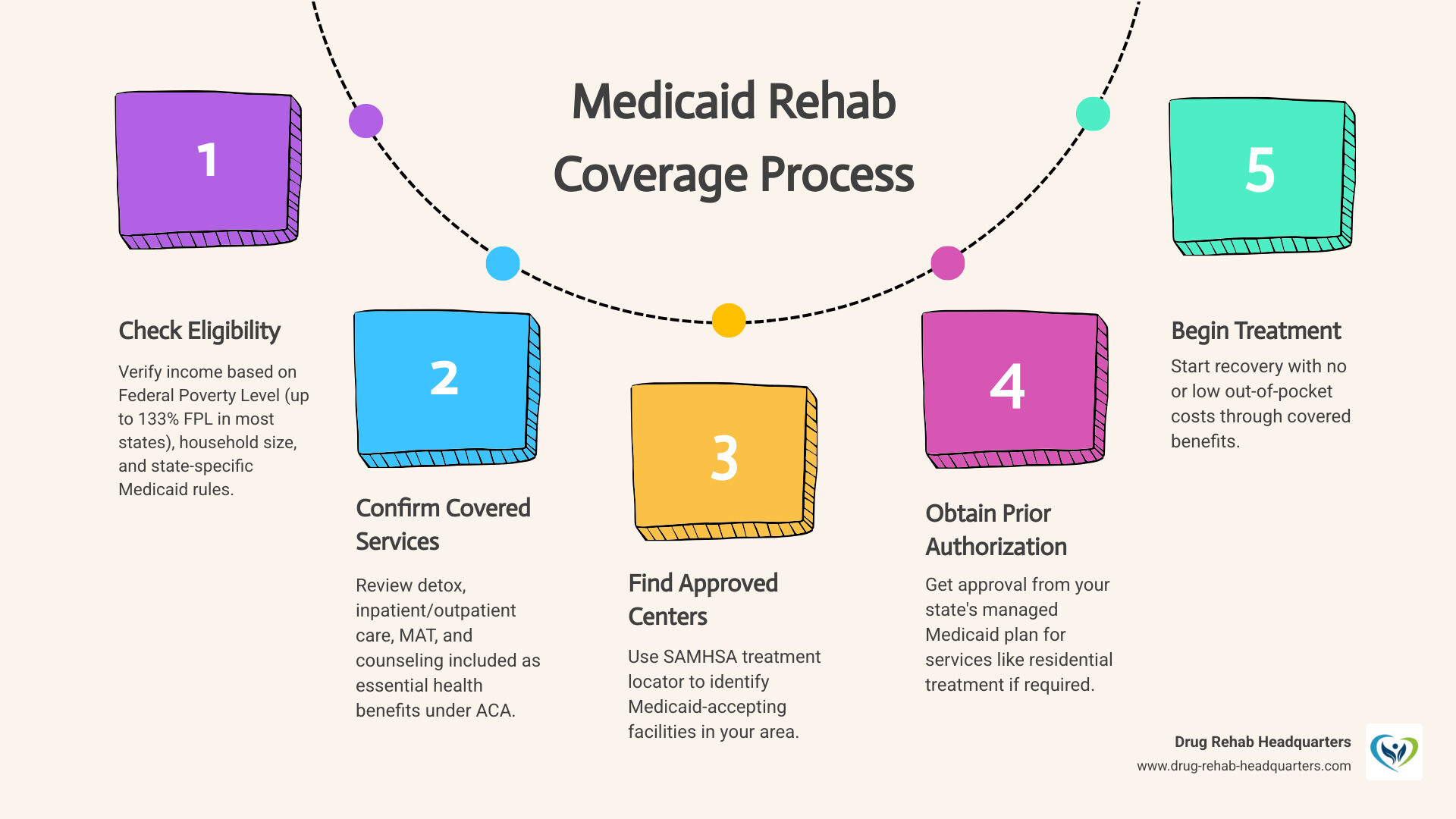
Finding the Best alcohol rehab centers that accept Medicaid requires a little bit of homework, but it’s worth the effort. Here is a step-by-step guide to getting started:
- Check Your Enrollment: Ensure your Medicaid status is active. You can do this by logging into your state’s benefits portal (like Access Nevada or Indiana’s FSSA portal).
- Use the SAMHSA Locator: The SAMHSA Treatment Locator allows you to filter results specifically for facilities that accept “Medicaid.”
- Call Your Insurance Card: Flip your Medicaid card over and call the member services number. Ask for a list of “in-network” substance use disorder providers.
- Get a Clinical Assessment: Most Medicaid plans require a “referral” or a clinical assessment from a licensed doctor or therapist to prove that rehab is medically necessary.
- Obtain Prior Authorization: Before you check in, the rehab center will usually contact Medicaid to get “prior authorization.” This is basically Medicaid saying, “Yes, we agree this person needs this care, and we will pay for it.”
At Drug Rehab Headquarters, we specialize in this “matching” process. We know which Addiction Treatment centers have the best reputations and which ones are currently accepting Medicaid. Call us at (866) 720-3784 to start your search.
Frequently Asked Questions about Medicaid and Rehab
What is the difference between Medicaid and Medicare for addiction?
This is a common point of confusion!
- Medicaid is a state/federal program for low-income individuals of all ages. It generally covers a very broad range of addiction services with little to no out-of-pocket cost.
- Medicare is a federal program primarily for people aged 65 and older or those with specific disabilities.
- Medicare Part A covers inpatient hospital stays (up to 190 days in a lifetime for psychiatric hospitals).
- Medicare Part B covers outpatient services and typically pays about 80% of the cost.
Some people are “dual eligible,” meaning they have both. In this case, Medicare pays first, and Medicaid often covers the remaining “gap” costs. For more on Medicare’s specific rules, see the guide on Medicare & Your Mental Health Benefits.
Are there out-of-pocket costs for Medicaid-covered rehab?
In most cases, Medicaid-covered rehab has very low or zero out-of-pocket costs. Some states may charge small co-payments (ranging from $1 to $5) for prescriptions or office visits, but many states waive these for substance abuse treatment to encourage people to seek help. However, if you choose a facility that is “out-of-network,” you could be responsible for the entire bill. Always verify that the facility is in-network first. You can read more about navigating these costs in The Price of Recovery: Understanding Rehab Costs and Finding Free Options. Our team at (866) 720-3784 can help you find affordable care.
What services are typically not covered by Medicaid?
While Medicaid is generous, it doesn’t cover everything. You generally won’t find coverage for:
- Luxury Amenities: Things like private chefs, equine therapy, or high-end spas.
- Private Rooms: Unless medically necessary, you will likely have a roommate.
- Holistic-Only Therapies: Treatments like Reiki or massage are usually not covered unless they are part of a larger, evidence-based clinical program.
- Out-of-State Travel: Medicaid is state-specific. It is very rare for one state’s Medicaid to pay for a non-emergency rehab stay in a different state.
Conclusion: Taking the Next Step Toward Recovery
Asking “Does Medicaid cover rehab?” is the first step toward a brand-new life. The answer is a hopeful “Yes,” but the path to getting there involves navigating state rules, eligibility limits, and facility waitlists. You don’t have to do this alone.
At Drug Rehab Headquarters, our mission is to connect you with the resources you need to heal. Our team of certified counselors—many of whom have walked this path themselves—is available 24/7 to offer free, confidential support. We can help you find Smart Choices, Sober Future: Affordable Drug Treatment Solutions that fit your specific Medicaid plan and your personal recovery goals.
Recovery is possible, and your financial situation shouldn’t stand in the way. Whether you need a detox center in Indiana, an outpatient program in Nevada, or just someone to listen, we are here for you.
Don’t wait another day to start your journey toward a healthier life.