
What Is Alcohol Withdrawal Detox — and How Do You Get Through It Safely?
Alcohol withdrawal detox is the process of clearing alcohol from your body after physical dependence has developed — and it can range from uncomfortable to life-threatening depending on your drinking history.
Here’s what you need to know right away:
- Start within hours: Symptoms can begin as soon as 6–12 hours after your last drink
- Peak danger window: The most severe symptoms — including seizures and delirium tremens — occur between 24 and 72 hours
- About 50% of people with alcohol use disorder (AUD) experience withdrawal symptoms when they stop drinking
- Medical supervision is often essential: Delirium tremens carries a mortality rate of 5–25% if untreated
- Most people complete detox in 4–10 days, though some symptoms can linger for weeks or months
- Call (866) 720-3784 if you or someone you love needs immediate guidance on safe detox options
The bottom line: do not attempt to stop drinking cold turkey without first talking to a medical professional, especially if you drink heavily or daily.
If you’re feeling overwhelmed right now — you’re not alone. Millions of people and families face this exact moment every year, unsure of what comes next or whether help is even possible. This guide is here to walk you through every stage of the process clearly and honestly.
At Drug Rehab Headquarters, we’ve spent years connecting individuals and families across North America with reputable, evidence-based alcohol withdrawal detox programs — helping people cut through the confusion and find care that actually fits their situation. We’re here to do the same for you.
Important alcohol withdrawal detox terms:
Call for immediate support: (866) 720-3784
Understanding Alcohol Withdrawal Detox and Treatment Options
When we talk about Alcohol Detox, we are describing the body’s attempt to find a new “normal” after being saturated with alcohol for a long time. Alcohol is a central nervous system depressant. To keep you functioning while you drink, your brain works overtime, amping up its excitatory chemicals to counteract the sedative effects of the booze.
Specifically, alcohol messes with your GABA receptors (the “brakes” of the brain) and creates a Glutamate imbalance (the “gas pedal”). When you suddenly stop drinking, the “brakes” disappear, but the “gas pedal” is still floored. This leads to CNS overexcitation, which is the root cause of the shakes, anxiety, and potentially dangerous seizures.
According to the Alcohol withdrawal: MedlinePlus Medical Encyclopedia, this physiological backlash is why Why Medical Detox for Alcohol is the Safest Bet. In a medical setting, doctors use medications to mimic the effects of alcohol on the brain, slowly stepping the dosage down so the brain doesn’t go into a life-threatening shock.
The Alcohol Withdrawal Detox Timeline
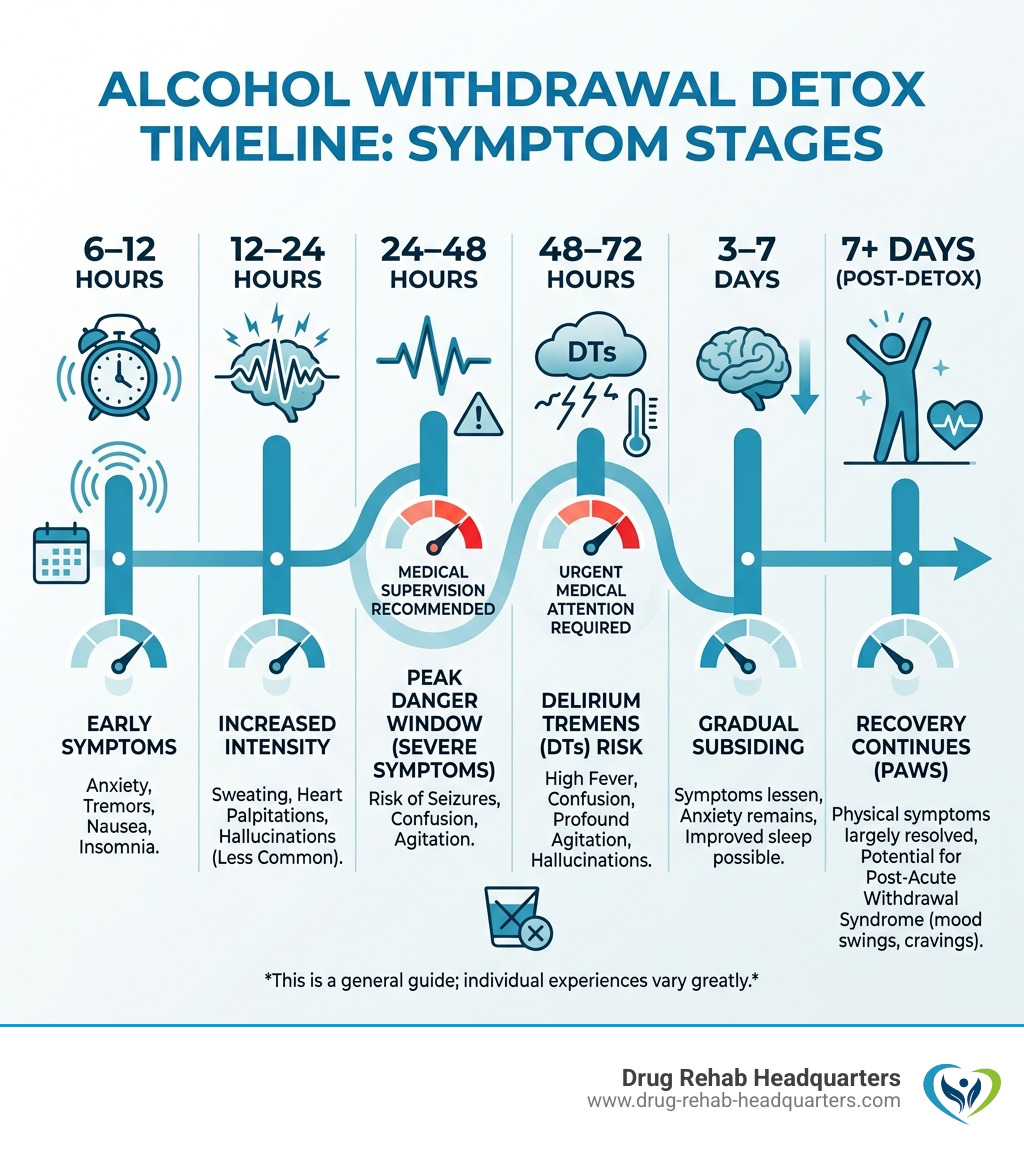
The journey of alcohol withdrawal detox isn’t a straight line; it’s more like a rollercoaster that peaks early and then gradually levels off. While every person is different, the medical community generally recognizes a standard timeline for these symptoms.
- 6 to 12 Hours: The “Minor” Stage. You might feel like you have a bad case of the jitters. Anxiety, insomnia, abdominal pain, and nausea are common. This is often when the first cravings hit hard.
- 12 to 48 Hours: The Danger Zone. This is when hallucinations (seeing or hearing things that aren’t there) can begin. More importantly, this is the primary window for withdrawal seizures.
- 48 to 72 Hours: The Peak. This is the most critical period. If a person is going to develop Delirium Tremens (DTs), it usually happens now. Symptoms include severe confusion, racing heart, high blood pressure, and fever.
- 72 Hours to 7 Days: The Subsiding. For most, the worst physical Alcohol Detox Symptoms begin to fade, though psychological symptoms like irritability and depression may persist.
We also have to watch out for the Kindling effect. This is a phenomenon where each subsequent withdrawal episode becomes more severe than the last. If you’ve detoxed three times before, the fourth time carries a much higher seizure risk. If you are worried about your history with withdrawal, please reach out to us at (866) 720-3784 for a confidential assessment.
Inpatient vs. Outpatient Alcohol Withdrawal Detox
Choosing the right level of care is arguably the most important decision you’ll make in early recovery. We follow the ASAM criteria (American Society of Addiction Medicine) to help determine where a person will be safest.
- Inpatient Medical Detox: This provides 24/7 monitoring by doctors and nurses. It is strongly recommended for heavy drinkers, those with a history of seizures or DTs, and individuals with co-occurring health issues like liver disease. It ensures clinical safety during the most volatile hours.
- Outpatient Detox: This may be an option for those with mild symptoms and a very strong support system at home. It involves daily check-ins with a clinic but allows you to sleep in your own bed.
As we explore in Detox Done Right: Exploring Medical Detox Programs for Addiction Recovery, the goal of inpatient care isn’t just safety—it’s comfort. Modern medicine can make the process significantly less painful than trying to “tough it out” alone.
Need help deciding which path is right for you? Call us at (866) 720-3784.
Alcohol Misuse Statistics and Accessing Care in North America
Alcohol use disorder is far more common than many people realize. As of May 2026, data shows that 28.8 million adults in the U.S. struggle with AUD. Despite how common it is, only a fraction seek professional help, often because they fear the withdrawal process.
The stakes are high. Research indicates that about 50% of people who stop drinking will experience some form of withdrawal. While many cases are mild, approximately 10% will face serious complications. Delirium Tremens, the most severe form of Alcohol withdrawal syndrome, occurs in up to 5% of patients and can have a 5–25% mortality rate if not managed in a hospital.
We provide resources and connections to detox centers across North America, including:
- The Northeast: Connecticut, Delaware, Maine, Maryland, Massachusetts, New Hampshire, New Jersey, New York, Pennsylvania, Rhode Island, Vermont.
- The South: Alabama, Arkansas, Florida, Georgia, Kentucky, Louisiana, Mississippi, North Carolina, Oklahoma, South Carolina, Tennessee, Texas, Virginia, West Virginia, Puerto Rico.
- The Midwest: Illinois, Indiana, Iowa, Kansas, Michigan, Minnesota, Missouri, Nebraska, North Dakota, Ohio, South Dakota, Wisconsin.
- The West: Alaska, Arizona, California, Colorado, Hawaii, Idaho, Montana, Nevada, New Mexico, Oregon, Utah, Washington, Wyoming.
No matter which county you reside in, there are local resources designed to keep you safe. Our team can help you find the closest facility that accepts your insurance and meets your specific medical needs. Give us a call at (866) 720-3784 to find a center near you.
Choosing a Safe Medical Detox Program
When you’re looking for a facility, you want to ensure they are using evidence-based care. A high-quality program doesn’t just put you in a bed and wait; they actively manage your symptoms using standardized tools.
One of the most important tools is the CIWA-Ar scale (Clinical Institute Withdrawal Assessment for Alcohol). Nurses use this to score your symptoms—like tremors, sweating, and anxiety—every few hours. This score tells the doctor exactly how much medication you need to stay safe.
Commonly used medications include:
- Benzodiazepines: These are the gold standard for preventing seizures and DTs.
- Thiamine (Vitamin B1): Chronic alcohol use depletes this vital vitamin. Supplementing it is crucial to prevent Wernicke-Korsakoff syndrome, a permanent and debilitating brain disorder.
- Anticonvulsants: Sometimes used as an alternative or adjunct to benzos to stabilize brain activity.
In the article Beyond the Shakes: Why Medical Detox is Crucial for Recovery, we emphasize that detox is just the beginning. A safe medical program will also help you transition into the next phase of treatment, whether that’s residential rehab or intensive outpatient therapy.
Get started on your safe journey today by calling (866) 720-3784.
Insurance and Financing Your Recovery
We know that “How much is this going to cost?” is usually the second question people ask (after “Will it hurt?”). The good news is that under the Affordable Care Act, most insurance plans are required to cover substance abuse treatment, including alcohol withdrawal detox.
| Insurance Type | Coverage Typicality | Pros | Cons |
|---|---|---|---|
| Private Insurance | High | Access to luxury or specialized facilities | May require high deductibles |
| Medicaid/State-Funded | Moderate to High | Low to zero out-of-pocket cost | Longer waitlists; fewer amenities |
| Self-Pay | N/A | Total privacy; immediate admission | Can be expensive ($1,000+ per day) |
| Scholarships/Grants | Varies | Helps those with zero income | Very competitive and limited |
Our Alcohol Detox Centers Guide 2026 provides a deeper dive into these options. We also recommend a verification of benefits before you arrive at a facility. Many centers offer sliding scale fees based on your income or flexible payment plans to make the cost manageable.
For more information on the clinical side of these costs, you can reference Alcohol Withdrawal: Symptoms, Treatment & Timeline. But the fastest way to find out what your specific plan covers is to call us at (866) 720-3784. We can run your insurance for free and tell you exactly what your options are.
Frequently Asked Questions about Alcohol Withdrawal Detox
How long does alcohol detox usually take?
The average duration for the acute phase of detox is between 7 and 10 days. Research shows that withdrawal symptoms last an average of 4.83 days for most, but the “danger zone” for seizures and DTs requires a full week of observation for many.
It’s also important to be aware of Post-acute withdrawal syndrome (PAWS). While the physical shakes might be gone in a week, psychological symptoms like “brain fog,” sleep disturbances, and mood swings can last for weeks or even months as the brain continues to heal.
Is it safe to detox from alcohol at home?
For someone with a long history of heavy drinking, the answer is often no. The seizure threshold can drop rapidly and without warning. Severe complications like Delirium Tremens cannot be managed with home remedies or “tapering” off on your own.
If a doctor clears you for home detox, you must have a 24/7 support person who knows the emergency signs (seizures, extreme confusion, fever, vomiting blood). However, for the vast majority of our clients, we recommend a clinical setting to ensure medical necessity is met and risks are minimized.
Does insurance cover the cost of alcohol detox?
Yes, in almost all cases. Whether you have a private provider (like Blue Cross, Aetna, or Cigna) or Medicaid, some level of detox coverage is standard. The verification process is something we handle daily at Drug Rehab Headquarters.
If you are looking for a specific Alcohol Detox Center, our counselors can help you find one that is “in-network” to keep your costs as low as possible.
Have more questions? Our certified counselors are available 24/7 at (866) 720-3784.
Conclusion
Navigating alcohol withdrawal detox is intimidating, but you don’t have to do it in the dark. At Drug Rehab Headquarters, we believe that everyone deserves a safe, dignified start to their recovery journey.
Our certified counselors—many of whom have lived experience with addiction—are here to provide 24/7 free support. We don’t just give you a list of names; we offer personalized guidance to find holistic treatment options that address your physical, emotional, and spiritual needs.
Whether you are in the heart of New York City or a small town in Wyoming, we have North America-wide resources ready to help you take that first, most important step. You’ve carried this burden long enough. Let us help you put it down.