
When One Diagnosis Isn’t Enough: Understanding Addiction and Mental Health Treatment Programs
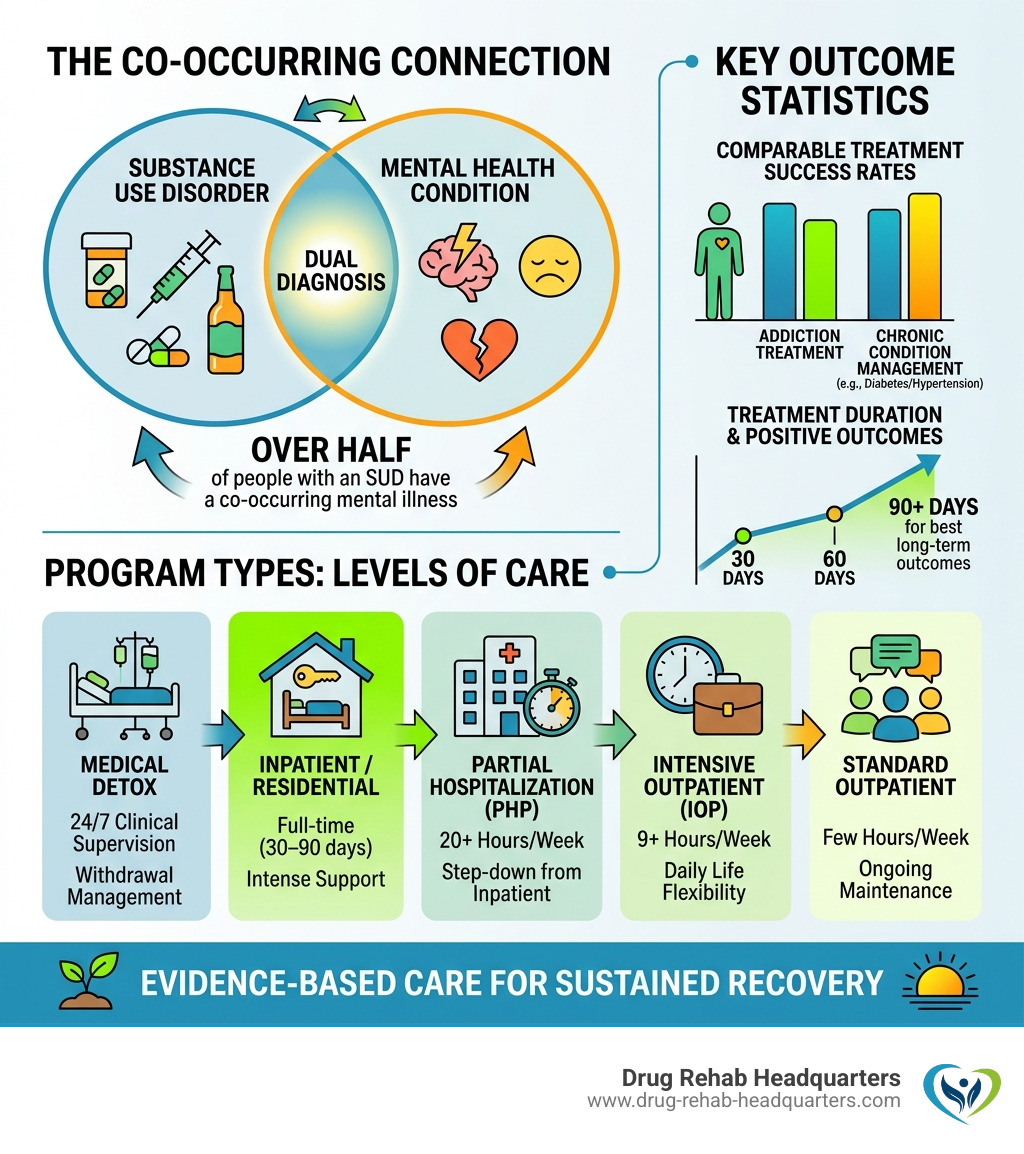
Addiction and mental health treatment programs are specialized care pathways that treat both substance use disorders and co-occurring mental health conditions — at the same time, in the same setting.
If you’re trying to quickly understand your options, here’s what you need to know:
| Program Type | Intensity | Best For |
|---|---|---|
| Medical Detox | 24/7 clinical supervision | Safe withdrawal management |
| Inpatient / Residential | Full-time, 30–90 days | Severe addiction or psychiatric needs |
| Partial Hospitalization (PHP) | 20+ hours/week | Step-down from inpatient |
| Intensive Outpatient (IOP) | 9+ hours/week | Moderate needs, daily life flexibility |
| Standard Outpatient | A few hours/week | Ongoing maintenance and support |
📞 (866) 720-3784 — Call now for a free, confidential assessment with a certified counselor.
Here’s the hard truth: about half of all people with a substance use disorder also live with a serious mental illness. That means treating addiction alone — without addressing anxiety, depression, trauma, or other conditions — often falls short. The two issues are deeply connected, each making the other worse if left untreated.
This is why dual diagnosis programs exist. They are designed to treat both conditions together, rather than bouncing a person between separate systems that don’t talk to each other.
The good news? Research shows that addiction treatment works at rates comparable to managing other chronic conditions like diabetes or hypertension. And the longer someone stays in treatment — at least 90 days — the better the long-term outcomes tend to be.
At Drug Rehab Headquarters, we’ve spent years helping individuals and families navigate the overwhelming landscape of addiction and mental health treatment programs, connecting people with evidence-based care that fits their unique situation and budget. In this guide, we’ll walk you through every major program type, what to look for, and how to get started.
Addiction and mental health treatment programs helpful reading:
Treatment Section: Levels of Care
Navigating recovery can feel like learning a new language. When we talk about “levels of care,” we are referring to the intensity of the program. Because addiction is often described as a chronic brain disease that alters decision-making, the level of support you need depends on your safety, the severity of your symptoms, and your home environment.
Medical Detox and Withdrawal Management
For many, the journey begins with detoxification. This isn’t just about “sobering up”; it’s about clinical stabilization. When someone has a heavy dependence on alcohol, opioids, or benzodiazepines, stopping “cold turkey” can be physically dangerous or even life-threatening.
- Medical Supervision: Doctors and nurses monitor vital signs and manage withdrawal symptoms 24/7 to ensure comfort and safety.
- Psychiatric Stabilization: Because mental health issues often flare up during withdrawal, medical detox provides a controlled environment to manage crisis situations.
- A Guide To Navigating Dual Diagnosis Drug Detox: Specialized detox units are equipped to handle the unique needs of those with co-occurring disorders, ensuring that psychiatric medications are balanced while the body clears toxins. Check out A Guide To Navigating Dual Diagnosis Drug Detox for more details.
Residential and Inpatient Treatment
Residential programs offer a safe, structured environment where you can focus entirely on healing. These are often the “gold standard” for addiction and mental health treatment programs because they remove the triggers of everyday life.
- Duration: Most stays range from 30 to 90 days. Statistics show that treatment episodes of 3 months or longer are often a predictor of a successful outcome.
- Integrated Care: You aren’t just attending “rehab” for drugs; you are receiving Behavioral Health services. This includes individual therapy, group sessions, and Bipolar Disorder Rehab if you struggle with mood swings.
- Holistic Approach: Many top-tier residential centers now include experiential therapies like art, yoga, and nature walks to help process emotions that words can’t always reach.
Outpatient and Intensive Support
Not everyone can step away from work or family for a month. Outpatient options provide flexibility while still offering evidence-based care.
- Partial Hospitalization (PHP): This is the most intensive outpatient level. You typically spend at least 20 hours per week at the facility (often 5 hours a day, 4-5 days a week) but return home at night. It’s perfect for those who need high-level Mental Help but are medically stable.
- Intensive Outpatient (IOP): This requires a minimum of 9 hours per week. It allows you to maintain a job or school schedule while attending therapy sessions in the evenings or mornings.
- Virtual Care and Telehealth: As of 2026, virtual IOP has become a game-changer. It removes barriers like transportation and is highly effective for those with mobility issues or those living in rural areas.
📞 Need help determining the right level of care? Call (866) 720-3784 for a free assessment.
Local Section: Resources and Outcomes
Finding help close to home can make a significant difference, especially when it comes to family involvement and aftercare. Whether you are looking for Substance Use Services in Alabama or Addiction Services in Connecticut, local resources are designed to meet the specific needs of your community.
Understanding Local Impact and Statistics
The demand for integrated care is rising across North America. In many states, Why Mental Health Treatment Centers Are In High Demand is a result of a better understanding of how trauma and addiction intersect.
- State Resources: Many states, like Alaska and Arkansas, provide directories of state-funded and private facilities.
- Community Support: Local 12-step groups (AA/NA) and the 988 Suicide & Crisis Lifeline provide immediate support for those in crisis.
- Long-Term Success: It is encouraging to know that almost 90 percent of those who remain abstinent for 2 years are also drug- and alcohol-free at 10 years.
Specialized Programs for Diverse Groups
Generic treatment doesn’t always work for everyone. The best addiction and mental health treatment programs offer specialized tracks for specific populations:
- LGBTQIA+: Addressing the unique stressors, stigma, and trauma faced by the community.
- Perinatal Care: Prioritizing pregnant and parenting women with evidence-based treatment to ensure the health of both mother and child.
- Veterans and First Responders: Focused Ptsd Treatment that addresses the “roots” of addiction in high-stress professions.
- Professionals: High-accountability programs that allow executives or healthcare workers to recover while protecting their careers.
📞 To find a local program that fits your needs, contact our team at (866) 720-3784.
Trust Section: How to Choose the Right Rehab
Choosing a facility is a big decision. You want to ensure you are putting your trust (and your resources) into a program that actually works. We recommend looking for “whole-person care,” which means the facility treats your emotional, mental, and physical health simultaneously.
What to Look For in a Quality Program
When you call a facility, ask these questions to gauge their quality:
- Is the program accredited? Look for the “Gold Seal” from the Joint Commission or CARF.
- What are the staff credentials? You want to see a multidisciplinary team of MDs, PhDs, and Mental Health Professionals Near Me.
- Is the treatment integrated? Integrated Healing: What You Need To Know About Co-Occurring Disorder Treatment explains that treating mental health as the primary diagnosis alongside addiction is essential for dual diagnosis success.
- Do they offer specialized care? If you have a specific condition, ensure they have experience with Schizophrenia Treatment Centers, Anxiety Disorder Treatment Centers, or Panic Disorder Treatment.
Medication-Assisted Treatment (MAT)
For many struggling with opioid or alcohol use, medication is a life-saving tool. MAT uses FDA-approved medications like methadone, buprenorphine, or Vivitrol to ease cravings and normalize brain chemistry. This isn’t “swapping one drug for another”; it’s using medicine to manage a chronic illness, similar to using insulin for diabetes. When combined with counseling, MAT significantly reduces the risk of overdose and improves long-term recovery rates.
📞 Speak with a counselor 24/7 at (866) 720-3784 to verify the clinical standards of a facility.
Money Section: Insurance and Payment Options
One of the biggest hurdles to starting addiction and mental health treatment programs is the cost. However, thanks to current laws, mental health and addiction services must be covered by insurance in a way that is comparable to physical health services.
Navigating Insurance Coverage
- Private Insurance: Most PPO and HMO plans cover a significant portion of Dual Diagnosis Treatment Facility costs. You can Verify Insurance easily with our team.
- Medicare: As of 2026, Medicare covers inpatient services (Part A), as well as outpatient, PHP (at least 20 hours/week), and IOP (at least 9 hours/week) under Part B.
- Medicaid: Many state-run programs accept Medicaid and offer discounted fees based on your ability to pay. No one should be denied life-saving care because of their financial situation.
Payment Assistance and Costs
The Cost of Rehab can range from “free” (state-funded) to “luxury” (private pay).
- Sliding Scale: Many community-based programs adjust their prices based on your income.
- Financing: Some facilities offer monthly payment plans to make the out-of-pocket costs more manageable.
- State Grants: Check with your state’s department of mental health for available grants that cover treatment for those without insurance.
📞 For a free insurance verification, call (866) 720-3784 today.
Frequently Asked Questions about Addiction and Mental Health Treatment Programs
How much do dual diagnosis programs cost?
The cost depends on the level of care and the amenities provided. Residential programs are the most expensive because they cover housing, food, and 24/7 medical staff. Outpatient programs are significantly more affordable. Most people find that insurance covers 60% to 100% of the cost. To get a specific estimate, it’s best to call and have your benefits verified.
How long does treatment typically last?
While 30 days is a common starting point, the most successful outcomes are linked to staying in a treatment continuum for at least 90 days. This might mean 30 days of residential care followed by 60 days of IOP or PHP. Recovery is a marathon, not a sprint.
Does Medicare cover mental health and addiction services?
Yes. Medicare Part A covers inpatient hospital stays, while Part B covers outpatient services, including screenings for depression and alcohol misuse. It also covers intensive outpatient programs at specific facilities like Opioid Treatment Programs (OTPs).
What is the difference between PHP and IOP?
Think of PHP (Partial Hospitalization) as a “full-time job” of recovery — you are there most of the day, every day. IOP (Intensive Outpatient) is more like a “part-time job” — you attend several times a week for a few hours, allowing you to sleep in your own bed and maintain some outside responsibilities.
📞 Have more questions? Call our helpline at (866) 720-3784.
Conclusion: Finding Your Path to Wellness
Choosing the right facility is the most critical step in your recovery journey. Whether you are dealing with Depression Treatment and alcohol use, or Ptsd Treatment and opioid dependence, there is a program designed for you.
At Drug Rehab Headquarters, we believe that everyone deserves a chance at a healthier, happier life. We connect individuals to evidence-based addiction and mental health treatment programs across North America, offering 24/7 free support from counselors who understand what you’re going through.
Don’t wait for a crisis to become a tragedy. Healing is possible, and it starts with a single phone call.
Search for Treatment | Addiction Treatment | Rehabilitation Services
Additional Resources:
- When Anxiety Disorder Treatment Is The Best Option
- When Treatment For Depression Is More Effective Than Medication
- What Makes Panic Disorder Treatment More Powerful Than Medication
- Why Treatment For Ptsd Is Beyond Important
- When Two Worlds Collide Finding Support For Mental Health Addiction
- Find Drug And Alcohol Rehab In Delaware
- Colorado Mental Health and Drug Help
- Hazelden Betty Ford Foundation
- Meadows Behavioral Healthcare