Why Affordable Drug Treatment Is Within Your Reach
Affordable drug treatment is available through multiple pathways regardless of your financial situation. Here are your primary options:
- State-Funded Programs: Free or low-cost treatment available to residents with demonstrated financial need
- Non-Profit Centers: Many non-profit organizations offer sliding scale fees or no-cost services
- Insurance Coverage: Most plans now cover substance abuse treatment under the Affordable Care Act
- Sliding Scale Fees: Payment amounts adjusted based on your income and family size
- Scholarships & Grants: Available through SAMHSA, local treatment centers, and community organizations
- VA Benefits: Free treatment for veterans whose addiction relates to military service
The statistics are sobering: in 2020, 41.1 million Americans needed substance use treatment, but only 4 million received it, with cost being the primary barrier. Many people believe that effective addiction treatment is financially out of reach, but this simply isn’t true.
The reality is that every state has affordable treatment options. State-funded centers serve adults regardless of financial resources or insurance status. Non-profit organizations have donated millions to make treatment accessible. The average cost of methadone maintenance treatment is approximately $4,700 per year—far less than the average cost of imprisonment at $24,000 per year, and infinitely less than the ongoing cost of addiction itself.
Free and low-cost treatment works. In the U.S., 45% of treatment centers provide free or minimal-payment options for those who cannot afford standard rates. These programs use evidence-based approaches and have helped countless individuals achieve lasting recovery.
At Drug Rehab Headquarters, we’ve guided thousands of individuals and families through the process of finding affordable drug treatment that meets their unique needs and budget. We understand that navigating the complex landscape of treatment options, funding sources, and program quality can feel overwhelming when you’re already struggling with addiction.
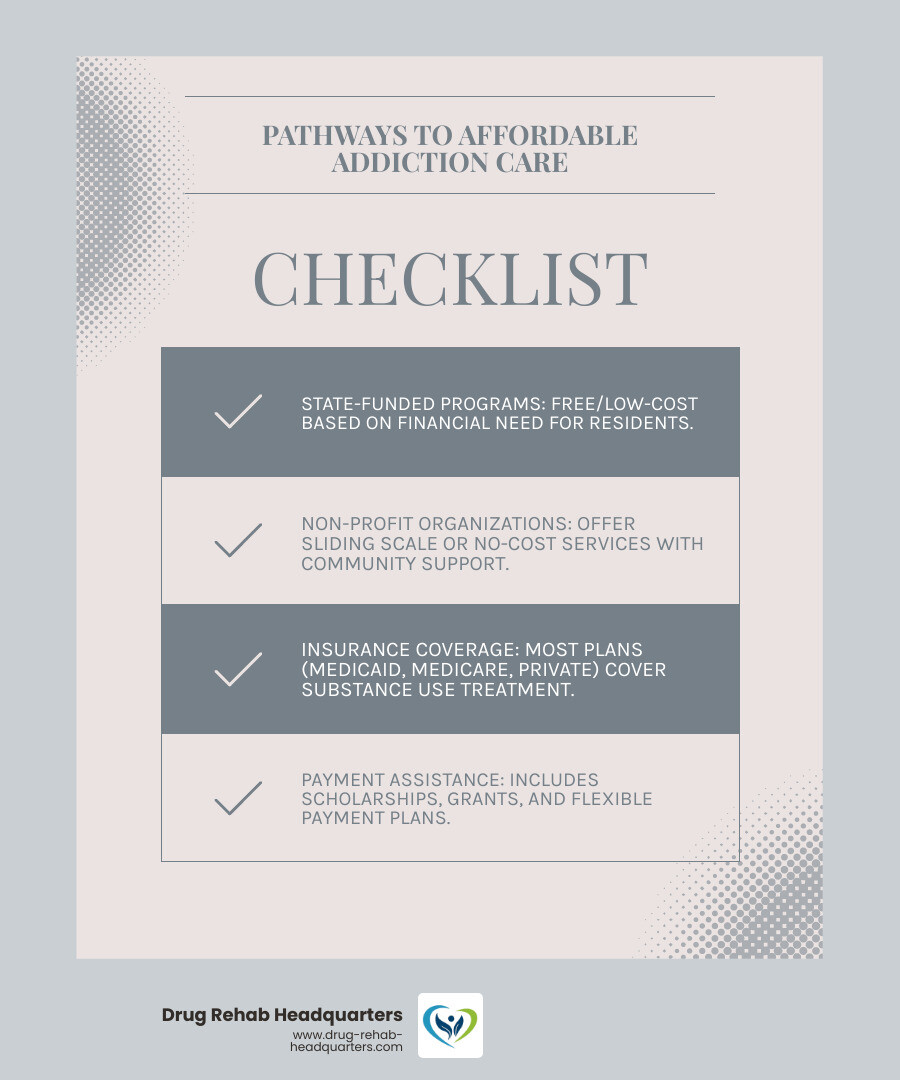
Infographic illustrating four main pathways to affordable addiction care: State-Funded Programs (showing government buildings and sliding scale), Non-Profit Organizations (showing community support), Insurance Coverage (showing insurance cards for Medicaid, Medicare, and private plans), and Payment Assistance (showing scholarships, grants, and flexible payment plans). Each pathway includes typical eligibility requirements and key benefits.
Understanding the Cost of Rehab: An Investment in Your Future
When facing addiction, the idea of paying for treatment can feel like an impossible obstacle. However, we want to shift your perspective: addiction treatment isn’t an expense, it’s an investment in your future. The cost of untreated addiction far outweighs the cost of rehab. Untreated substance abuse costs the U.S. over $600 billion annually in lost productivity, healthcare expenses, and criminal justice costs. For every dollar invested in addiction treatment, there’s a return of $4 to $7 in reduced crime and justice costs, and potentially up to $12 when healthcare savings are included.
The financial toll of addiction itself is staggering, with costs for substances, legal fees, and lost wages easily reaching tens of thousands of dollars annually. When you look at it this way, affordable drug treatment becomes not just a possibility, but a financial imperative.
The average cost of drug rehabilitation per person in the U.S. is a broad figure that can vary widely. For instance, residential treatment can average over $50,000, while outpatient treatment can average under $2,000 for a single admission. These numbers might seem intimidating, but remember, many options exist to make these costs manageable or even free. For a detailed breakdown of costs and how to manage them, you can always visit our comprehensive guide on the Cost of Rehab.

How Treatment Type and Amenities Influence Price
The cost of addiction treatment is not a one-size-fits-all number. It’s influenced by several factors, including the type of treatment, its duration, and the amenities offered. Understanding these variables can help you make an informed decision that aligns with your budget and needs.
Detoxification (Detox): This is often the first step, managing the physical symptoms of withdrawal. Costs generally range from $250 to $800 per day. A typical 7-day detox program could cost anywhere from $1,750 to $5,600. More intensive options can cost up to $10,000.
Inpatient vs. Outpatient Treatment: This is one of the biggest differentiators in cost.
- Inpatient Rehabilitation: This involves residing at the treatment facility 24/7. It’s more intensive and, consequently, more expensive. A 30-day inpatient program can range from $5,000 to $20,000, while longer 60- to 90-day programs can cost between $12,000 and $60,000. These costs cover accommodation, meals, therapy, and medical care.
- Outpatient Rehabilitation: This allows individuals to live at home while attending treatment. It’s less intensive and more flexible, making it a more affordable drug treatment option. The cost of outpatient rehab for a 3-month program can be around $5,000, while Intensive Outpatient Programs (IOPs) might cost $15,000 to $19,500 over 30 days.
Program Duration: Generally, longer programs cost more in total, but often offer a lower daily rate. While a 30-day program might seem more budget-friendly upfront, research consistently shows that longer durations (at least 90 days) lead to better long-term outcomes.
Amenities and Level of Care: Costs diverge based on amenities. A luxury rehab center with private rooms and spa services will be significantly more expensive than a basic, publicly funded center. The level of medical and psychiatric care available also impacts price.
To help visualize these differences, here’s a quick comparison:
| Treatment Type | Average Cost Range (per unit) | Typical Duration | Intensity Level |
|---|---|---|---|
| Detox | $250 – $800 per day | 3-10 days | High (Medical) |
| Outpatient | $1,400 – $10,000 per month | 3-12 months | Low to Moderate |
| Intensive Outpatient (IOP) | $15,000 – $19,500 per month | 1-3 months | Moderate to High |
| Inpatient | $5,000 – $20,000 per month | 30-90+ days | High (Residential) |
Your Guide to Free and Affordable Drug Treatment Options
We firmly believe that financial limitations should never be a barrier to recovery. That’s why we’re committed to helping you steer the landscape of free and affordable drug treatment options. There are numerous avenues to explore, from state-funded initiatives to non-profit organizations and community-based support systems.
In the United States, there are hundreds of facilities that offer free treatment for all clients, and 45% of centers provide free or minimal payment treatment for those who can’t afford standard rates. These aren’t just limited options; many offer comprehensive, evidence-based care.

State-Funded Programs: Many states offer affordable drug treatment by funding services through public mental health or substance use treatment centers. These programs are often available to individuals with no health insurance, low income, or significant financial need. A key example of government funding for rehabilitation is the SAMHSA block grants, which fund treatment for individuals without insurance or for services not covered by other insurance.
Non-Profit Organizations: Many national and local non-profits are dedicated to making treatment accessible. They often operate on donations and grants, offering services on a sliding scale or for free. These include faith-based programs known for no-fee residential care, as well as secular organizations that provide scholarships and help individuals access state-funded services.
Community-Based Recovery Resources: These informal, peer-led support groups are typically free and play a vital role in long-term recovery.
- Alcoholics Anonymous (AA) and Narcotics Anonymous (NA): These programs use mentors and self-organized support groups to guide individuals through the Twelve Steps to addiction recovery. Meetings are usually free, though voluntary contributions are often accepted to cover operational costs.
Eligibility for Affordable Drug Treatment Programs
Accessing free or low-cost drug treatment programs often comes with specific eligibility requirements. While criteria can vary, here are the common factors:
- Proof of Income and Financial Need: You’ll typically need to provide financial documentation like pay stubs or tax returns to qualify for reduced fees or free services.
- Lack of Insurance or Underinsurance: Many programs prioritize individuals who do not have health insurance or whose coverage is insufficient.
- State and Legal Residency: For state-funded programs, you must typically be a legal resident of that state. Some programs may also require proof of legal U.S. residency.
- Priority Populations: To address public health needs, many programs prioritize certain demographics, such as pregnant women, veterans, individuals with HIV/AIDS, and those referred by the criminal justice system.
Information Needed for Admission: To apply for these facilities, you’ll generally need personal identification, proof of residency, financial documentation, insurance information (if any), and your medical history.
Finding State-Funded Affordable Drug Treatment
Finding state-funded affordable drug treatment can seem daunting, but there are clear pathways to follow. These programs are primarily supported by federal and state taxes, as well as grants from the Substance Abuse and Mental Health Services Administration (SAMHSA).
How to Use Local Health Departments and Treatment Centers:
- SAMHSA Behavioral Health Treatment Services Locator: This is an invaluable tool. You can search for state-funded rehab centers near you by visiting SAMHSA Behavioral Health Treatment Services Locator. Alternatively, you can call their free helpline at 1-800-662-HELP (4357).
- Single State Agencies (SSAs) for Substance Use Services: SAMHSA also provides an online directory of SSAs. You can use this directory to find the government agencies in your state that deliver rehabilitation programs for those with low incomes or no insurance. Access this directory at Single State Agencies (SSAs) for Substance Use Services.
- Local Health Departments: Your county or city health department can provide information on local resources, state-funded programs, and referral services.
For example, some states like North Carolina operate state-run Alcohol and Drug Abuse Treatment Centers (ADATCs). Admission is typically handled through regional health entities (LME/MCOs), and costs are based on a sliding scale, ensuring financial status is not a barrier to entry. These centers provide medically monitored detox, crisis stabilization, and evidence-based therapies.
We’ve seen many individuals successfully access care through these avenues, such as a single parent with no insurance securing a spot in a state-funded detox program, or another person with a low income finding long-term residential care through a non-profit. These stories prove that help is available for those facing financial hardship.
How to Pay for Treatment: Insurance and Financial Assistance
Beyond free and state-funded programs, several other payment options can make affordable drug treatment a reality. We understand that navigating these options can be complex, but we’re here to help clarify the path forward.
Sliding Scale Fees: Many non-profit and some private facilities offer sliding scale fees. This means the cost of treatment is adjusted based on your income and family size. The lower your income, the less you’ll pay. To qualify, you’ll usually need to provide proof of income and family size.
Payment Assistance Plans: Many rehab centers offer in-house payment plans, allowing you to pay for treatment in installments over time rather than a lump sum upfront. This can significantly reduce the immediate financial burden.
Rehab Scholarships and Grants:
- SAMHSA Individual Grants: In addition to block grants for facilities, SAMHSA sometimes offers grants directly to individuals who cannot pay for addiction treatment.
- Clinical Trials: Funding is often available from the National Institute on Drug Abuse (NIDA) and other research bodies for individuals participating in clinical trials. This allows you to receive treatment at no cost while contributing to scientific research. You can search for trials at www.clinicaltrials.gov.
- Non-Profit Organizations: Some non-profits partner with rehab centers to provide scholarships for qualifying applicants. Many local treatment centers, community organizations, and churches also offer their own scholarship programs.
Medical Loans: While not ideal for everyone, medical loans can be an option if other forms of assistance aren’t sufficient. These are specialized loans designed for healthcare expenses, often with more flexible terms than personal loans.
For more information on how insurance can help cover treatment costs, please see our guide: Does Insurance Cover Rehab?.
Leveraging Insurance and Government Benefits
The landscape of insurance coverage for addiction treatment has significantly improved, making affordable drug treatment more accessible than ever before.
Overview of Insurance Coverage for Rehab: Thanks to the Affordable Care Act (ACA), treatment for substance use disorders is considered an essential health benefit. This means all Marketplace health insurance plans and most individual and small group plans must cover it, so your insurance likely covers at least a portion of your treatment.
Medicaid and Medicare Options:
- Medicaid: Yes, Medicaid pays for rehabilitation in drug and alcohol treatment centers that accept this form of insurance. Under the ACA, Medicaid expansion programs must include substance use treatment services. It’s crucial to confirm that a specific rehab center accepts Medicaid before enrolling.
- Medicare: For those aged 65 or older, or with certain disabilities, Medicare can also cover addiction treatment services. This typically includes inpatient, outpatient, and partial hospitalization programs.
Using Veterans’ Benefits for Addiction Treatment: Veterans, active military personnel, and their families can access VA benefits that treat addiction. Veterans Affairs Health Care provides comprehensive treatment for substance use disorders. If your drug treatment needs are related to your military service, the treatment may be entirely free.
To understand your specific insurance benefits and how they apply to addiction treatment, we encourage you to use our convenient verification tool: Verify Insurance.
Vetting a Quality Rehab: What to Look For
When seeking affordable drug treatment, it’s crucial not to compromise on quality. A reputable rehab center will offer effective, evidence-based care that supports long-term recovery. Here’s what to look for to ensure you’re choosing a quality facility:
-
Accreditation and Licensure: These are non-negotiable trust factors.
- Accreditation: Look for accreditation from recognized bodies such as the Commission on Accreditation of Rehabilitation Facilities (CARF) or The Joint Commission. These accreditations signify that a facility meets rigorous standards for patient care, safety, and operational excellence.
- State Licensure: Ensure the facility is licensed by the state’s Department of Health and Human Services or equivalent regulatory body. This confirms that the center operates legally and adheres to state-specific regulations.
- Other Certifications: For specific programs, such as Opioid Treatment Programs (OTPs), look for certifications from SAMHSA/CSAT.
-
Evidence-Based Therapies: A quality rehab center will use therapeutic approaches proven effective by scientific research. These include:
- Cognitive-Behavioral Therapy (CBT): Helps individuals identify and change problematic thought patterns and behaviors.
- Motivational Improvement Therapy (MET): Helps individuals resolve ambivalence about treatment and commit to change.
- Medication-Assisted Treatment (MAT): Combining medications (like methadone, buprenorphine, naltrexone) with counseling for opioid and alcohol use disorders.
- 12-Step Facilitation Therapy: Encourages participation in 12-step programs like AA or NA.
- Family Behavior Therapy (FBT) and Multisystemic Therapy (MST): Especially effective for adolescents, involving family systems.
-
Certified Counselors and Qualified Staff: Look for facilities staffed by licensed and certified professionals, including:
- Addiction counselors (Licensed Professional Counselors – LPC, Licensed Alcohol and Drug Counselors – LADC).
- Medical doctors, nurses, and psychiatrists.
- Psychologists and social workers.
- Certified Peer Support Specialists: Many of our own certified counselors have lived experience, offering invaluable empathy and guidance.
-
Specialized Programs for Different Demographics: Addiction affects everyone differently. Quality centers often offer custom programs for specific groups:
- Men and Women: Addressing gender-specific issues and trauma.
- LGBTQ+ Community: Providing affirming and inclusive care.
- Individuals with HIV/AIDS: Integrating medical care with addiction treatment.
- Criminal Justice Clients: Programs designed for those referred by the legal system, often with a focus on reintegration.
- DUI/DWI Offenders: Specific educational and therapeutic components.
- Adolescents: Developmentally appropriate care that often involves family.
- Veterans: Programs sensitive to military-related trauma and experiences.
-
Holistic and Integrated Approaches: Beyond core therapies, consider centers that offer:
- Treatment for Co-Occurring Disorders: Integrated care for both substance use and mental health issues.
- Holistic Therapies: Yoga, meditation, art therapy, and other wellness activities to support overall well-being.
- Family Programs: Involving loved ones in the recovery process.
-
Aftercare Planning: Long-term recovery doesn’t end when a program does. A good facility will provide robust aftercare planning, including:
- Referrals to sober living homes.
- Connections to outpatient therapy and support groups.
- Relapse prevention strategies.
- Ongoing peer support.
By prioritizing these factors, you can find an affordable drug treatment program that offers high-quality care and a strong foundation for lasting sobriety.
Frequently Asked Questions about Affordable Treatment
What is the difference between inpatient and outpatient treatment and how does it affect cost?
The core difference lies in the living arrangements and intensity of care, which directly impacts the cost.
- Inpatient Addiction Treatment: This is a residential program where you live at the facility 24/7. It is the most intensive and expensive option, with 30-day programs ranging from $5,000 to $20,000. It’s ideal for severe cases as it provides a structured, supervised, and trigger-free environment.
- Outpatient Addiction Treatment: This allows you to live at home while attending scheduled therapy sessions. It’s more flexible and a more affordable drug treatment choice, with costs for a three-month program often around $5,000. It allows you to maintain daily responsibilities like work or school.
The right choice depends on the severity of the addiction, the stability of your home environment, and your financial resources. While inpatient is more costly, its immersive nature can be crucial for some, while outpatient requires a strong commitment and a supportive home life.
Are there waiting lists for free or state-funded rehab centers?
Yes, waiting lists are a common reality for many free or state-funded rehab centers due to high demand and limited funding. This can be a significant disadvantage, as studies show that waiting to start treatment increases health risks.
It’s important to be proactive: apply early and explore multiple options simultaneously. Some centers offer pre-admission peer support services to help individuals on waiting lists stay engaged and prepare for treatment.
What basic services are offered by most free or low-cost rehabs?
Even at free or low-cost rehabs, you can expect to receive a range of essential, evidence-based services to support recovery. While luxury amenities might be absent, the core components of effective treatment are typically provided. Common services include:
- Assessment and Evaluation: An initial assessment to create a personalized treatment plan.
- Detoxification: Medically supervised detox to manage withdrawal symptoms safely.
- Individual and Group Counseling: Therapy sessions to address root causes and learn from peers.
- Substance Abuse Education: Workshops on the nature of addiction and healthy living.
- 12-Step Program Integration: Encouragement to participate in groups like AA or NA.
- Relapse Prevention and Aftercare Planning: Creating a plan for continued support after treatment.
- Case Management: Connecting individuals with community resources for housing, employment, and healthcare.
Your Path to Recovery Starts Now
The journey to recovery can feel overwhelming, but we hope this guide has shown you that affordable drug treatment is not just a dream, but a tangible reality. Regardless of your budget, there are multiple pathways available to help you reclaim your life. From state-funded programs and non-profit organizations offering free or sliding-scale services, to leveraging insurance benefits and exploring grants, the resources are out there. The most crucial step is reaching out.
At Drug Rehab Headquarters, we understand the courage it takes to seek help. That’s why we offer 24/7 free, confidential support from certified counselors. Many of our counselors have lived experience, providing a unique blend of professional expertise and empathetic understanding. We’re here to offer personalized guidance, helping you steer your options and find suitable, evidence-based, and holistic treatment solutions that fit your unique needs and budget across North America.
Don’t let cost be the barrier between you and a healthier, sober future. Take the first step today. We’re ready to help you Find an inpatient drug rehab program that fits your needs and budget.